Overview
The Caribbean Development Bank (CDB) is issuing its Sustainable Bond under the CDB Sustainable Finance Framework to finance projects that foster climate resilience, environmental sustainability, and inclusive social and economic growth across the Caribbean region.
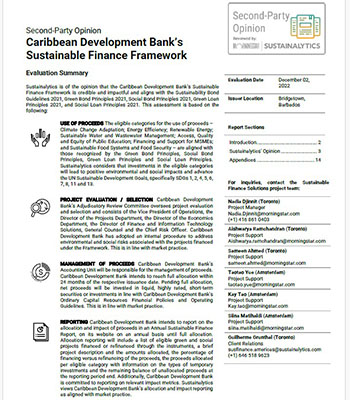
Aligned with the Green Bond Principles, Social Bond Principles, and Sustainability Bond Guidelines of the International Capital Market Association (ICMA), this bond provides investors with a transparent, credible, and impactful vehicle to support the region’s transition to a greener, stronger, and more inclusive future.
Proceeds from the bond will be exclusively allocated to eligible green and social projects within CDB’s Borrowing Member Countries (BMCs), targeting areas such as climate change adaptation, renewable energy, energy efficiency, sustainable water and wastewater management, education, food security, and support for micro, small and medium-sized enterprises (MSMEs).
Through this issuance, CDB aims to:
-
Enhance climate and disaster resilience in vulnerable small island economies.
-
Accelerate low-carbon and sustainable infrastructure investment.
-
Advance social inclusion and equitable access to opportunity.
For investors, this Sustainable Bond represents an opportunity to participate in financing high-impact projects that deliver measurable environmental and social outcomes, while benefiting from CDB’s strong credit standing, prudent management of proceeds, and robust annual reporting on allocation and impact.
The issuance underscores CDB’s ongoing commitment to embedding sustainability across its operations and leveraging capital markets to build a resilient and prosperous Caribbean.
Core Components of Framework
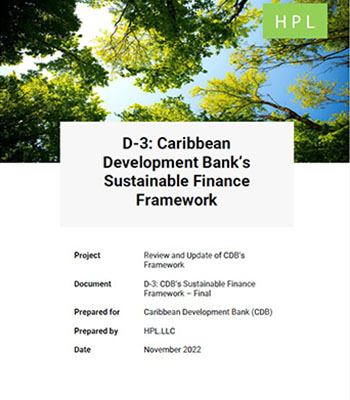
CDB’s Framework presents the guiding principles for CDB to issue Green, Social, and/or Sustainability Bonds as well as Green and/or Social Loans. The Framework has been developed taking into consideration established best market practices.
CDB’s Sustainable Finance Framework includes the following four core components:
- Use of proceeds
- Process for project evaluation and selection
- Management of proceeds
- Reporting
It is CDB’s intention to follow market best practices as the standards develop over time, therefore CDB may update this Framework.
Focal Sectors

Climate Change Adaptation
Improving climate resilience and capacity to manage disaster risk and climate change impacts in BMCs and integrating climate change adaptation measures in construction or upgrades of infrastructure projects.

Energy Efficiency

Financing and Support for MSMEs

Renewable Energy

Sustainable Food Systems and Food Security

Sustainable Water and Wastewater Management
The evaluation is integrated into the CDB’s existing project cycle and begins with an initial review by the project manager to determine if a project qualifies under the framework's eligibility criteria.
A Sustainable Finance Approval Working Group, consisting of senior CDB officials, makes the final decision, ensuring alignment with strategic goals and compliance with the Bank’s Environmental and Social Review Procedures (ESRP).
Projects are assessed for their potential environmental and social risks, and only those that adhere to best practices and fit within the established eligibility categories are approved. In cases of any significant changes or controversies, the Working Group has the authority to replace an ineligible project with a qualifying one.
This process ensures that all projects funded under the Sustainable Finance Instruments contribute effectively to the Bank's objectives of building environmental and social resilience in its Borrowing Member Countries (BMCs).
The proceeds from the Sustainable Finance Instruments are deposited into a dedicated sub-account, overseen by the Treasury Unit, and are allocated to eligible Green and Social Projects within 24 months. Unallocated funds are temporarily invested in liquid, highly-rated, short-term securities until they are used. If a project becomes ineligible, the proceeds are redirected to another qualifying project. The allocation of funds is tracked and externally verified, with details reported annually to ensure transparency and accountability.
CDB is committed to providing transparent and regular reporting on the use of proceeds from its Sustainable Finance Instruments. Within the first 12 months of issuance and annually thereafter, CDB will publish an Annual Sustainable Finance Report. This report includes allocation reporting, which details the projects financed, the percentage of funds used for financing versus refinancing, and any remaining unallocated proceeds. Additionally, impact reporting highlights the environmental and social outcomes of the funded projects, using specific quantitative indicators. The report, approved by the Sustainable Finance Working Group, will be available on CDB’s website to maintain accountability.
Disclaimer: This information has been prepared by the Caribbean Development Bank (CDB) for information purposes only. CDB makes no representation, warranty, or assurance of any kind, express or implied, as to the accuracy or completeness of any of the information contained herein. This investor brief may include information relating to certain CDB securities. Any such information is provided only for general informational purposes and does not constitute an offer to sell or a solicitation of an offer to buy any CDB securities. The securities mentioned herein may not be eligible for sale in certain jurisdictions or to certain persons.