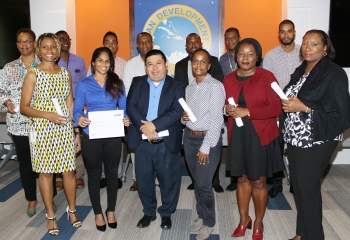
Honourable colleagues, General Counsels, distinguished representatives of international financial institutions, partners, friends, and members of the Caribbean Development Bank family, welcome to the 2026 Annual Meeting of International Financial Institutions General Counsels. It is a pleasure to host you here in Barbados at the headquarters of the CDB. I extend a warm Caribbean welcome to each of you and offer my sincere appreciation for your participation in this forum.
I’m deeply sorry I couldn’t be with you in person today but please know that you are in excellent hands. The team at the Bank has poured their hearts into making this gathering a meaningful and memorable success, and I know they will take wonderful care of you.
This gathering takes place at a consequential moment. We are operating in an environment characterised by geopolitical uncertainty, economic fragmentation, technological disruption, climate volatility, and rising expectations from the countries and communities we serve. These forces are reshaping development finance, institutional governance, and the legal frameworks that support both.
In recent months, I have spoken about what I describe as the Caribbean’s decade of decision. For our region, the choices we make now will determine whether we emerge more resilient, more competitive, and more inclusive, or become increasingly vulnerable to external shocks. The same principle applies to our institutions. The decisions we take today about governance, risk, innovation, accountability, and cooperation will shape the development effectiveness of multilateral institutions for years to come.
The work of General Counsels has never been more important.
The legal function is no longer confined to interpreting rules or managing legal risk. Today, General Counsels sit at the centre of institutional transformation. You help institutions navigate uncertainty, enable innovation, safeguard integrity, strengthen accountability, and ensure that ambitious development objectives are pursued within sound governance frameworks.
The agenda for this meeting reflects that reality. Over the next two days, you will engage on artificial intelligence and its implications for legal practice; ethical conduct and whistleblower frameworks; collaboration among legal departments across the multilateral system; institutional independence and governance; geopolitical developments; climate finance; procurement policy; and other emerging issues that are redefining the operating environment for international financial institutions.
These are not isolated topics. They are interconnected manifestations of a broader challenge: how do we preserve trust, legitimacy, and effectiveness while adapting to a rapidly changing world?
At the Caribbean Development Bank, we have been asking ourselves that same question.
Earlier this year, our Board approved the Bank’s Strategic Plan for 2026 to 2035. The strategy is anchored in a simple but urgent premise: resilience must become the organising principle of Caribbean development.
Accordingly, the strategy is built around three mutually reinforcing pillars: social resilience, economic resilience, and environmental resilience.
Social resilience focuses on people. It recognises that sustainable development depends on strengthening access to quality education, healthcare, social protection, and opportunity. Economic resilience centres on creating stronger, more diversified, and more productive economies that can withstand shocks while sustaining inclusive growth. Environmental resilience reflects an undeniable reality for the Caribbean: climate change is not a future risk. It is a present and existential challenge.
Supporting these pillars are three operational priorities: youth, institutions, and climate action.
I mention institutions deliberately. Strong institutions are indispensable to development outcomes. Investment capital matters. Technical expertise matters. But effective implementation ultimately depends upon institutions that are transparent, accountable, capable, and trusted.
That observation brings us directly to the significance of this meeting.
The legal departments represented in this room are among the guardians of institutional strength. Through your advice, stewardship, and judgment, you help ensure that development institutions remain credible and effective even as circumstances evolve.
Consider the first major theme on your agenda: artificial intelligence (AI).
AI presents extraordinary opportunities for development institutions. It can enhance productivity, improve access to information, strengthen decision-making, and help organisations deliver services more efficiently. Yet it also raises profound questions regarding governance, accountability, data privacy, intellectual property, algorithmic bias, cybersecurity, and institutional responsibility.
The challenge before us is not whether AI will become part of our operations. It already has. The challenge is ensuring that innovation proceeds responsibly and consistently with the values that underpin our institutions.
In that regard, legal departments will play an essential role in shaping governance frameworks that promote innovation while protecting institutional integrity and public trust.
A second theme concerns ethics, codes of conduct, whistleblower protections, and institutional culture.
At a time when public confidence in institutions is under pressure globally, ethical leadership is not optional. Integrity remains one of the most valuable assets any multilateral institution possesses.
Our stakeholders expect us to manage resources responsibly, make decisions fairly, and uphold the highest standards of professional conduct. Maintaining those standards requires more than policies and procedures. It requires cultures that encourage accountability, transparency, and ethical decision-making.
Your discussions in this area are therefore fundamentally about preserving legitimacy, which is the foundation upon which development partnerships are built.
Another particularly important item on the agenda is how legal functions across multilateral development banks and international financial institutions can work more effectively as a system.
The challenges confronting our member countries do not respect institutional boundaries. Climate change does not distinguish between development banks. Food insecurity does not recognise organisational mandates. Natural disasters do not pause to consider our governance structures.
As a result, our effectiveness increasingly depends upon our ability to collaborate.
Multilateral development bank coordination is more important today than at any point in recent history. Our institutions collectively possess enormous knowledge, experience, financial capacity, and convening power. When we coordinate effectively, we can reduce duplication, accelerate delivery, harmonise approaches, and produce better outcomes for our member countries.
The legal community has a particularly important contribution to make in this regard. Greater cooperation among legal departments can support more efficient project delivery, facilitate co-financing arrangements, strengthen policy consistency where appropriate, and promote the exchange of knowledge regarding emerging risks and best practices.
Importantly, working as a system does not require uniformity. Each institution has its own mandate, governance framework, and comparative advantages. What it does require is a willingness to learn from one another, share expertise, and pursue practical solutions where collective action creates value.
The Caribbean Development Bank is deeply committed to that philosophy.
Colleagues, your discussions on institutional independence, governance, charter interpretation, and the role of independent accountability and integrity mechanisms are equally timely.
Development institutions must continuously balance independence with accountability, innovation with prudence, and efficiency with due process. Maintaining that balance is rarely simple, particularly in periods of geopolitical tension and rapid change. Yet it is precisely during such periods that sound governance principles matter most.
The same can be said for the conversations you will have regarding conflict, geopolitics, climate investment, procurement frameworks, and financing boundaries. These issues increasingly shape the environment within which development institutions operate and influence how resources are mobilised, allocated, and protected.
For Caribbean countries, many of which face high debt burdens, climate vulnerability, capacity constraints, and exposure to external shocks, the quality of multilateral support remains critically important. Legal and governance frameworks can either enable development solutions or unintentionally create obstacles to implementation. This makes your work both strategic and consequential.
As you engage over the coming days, I encourage you to approach these discussions not only through the lens of institutional responsibility but also through the perspective of the people ultimately affected by our decisions.
Behind every financing agreement, procurement framework, governance policy, integrity procedure, and climate fund arrangement are citizens who expect tangible improvements in their lives. Students seeking educational opportunity. Entrepreneurs creating jobs. Farmers adapting to changing weather patterns. Communities rebuilding after disasters. Families pursuing greater security and prosperity.
Our legal frameworks matter because development outcomes matter.
I therefore hope that this meeting serves not only as a forum for technical discussion but also as an opportunity to deepen relationships, strengthen professional networks, and identify practical avenues for continued collaboration across institutions.
The conversations that begin in these rooms have the potential to influence policies, improve practices, and strengthen the multilateral system as a whole.
Let me conclude by thanking our General Counsel, Diana Wilson Patrick, and her team for their leadership in organising this meeting. I also thank all participating institutions for your engagement and partnership.
The Caribbean has long understood the importance of community, cooperation, and resilience. Those values are reflected in the work of multilateral development banks and international financial institutions at their best.
As we navigate this decade of decision together, let us continue building institutions that are trusted, agile, innovative, and effective; institutions capable of meeting today's challenges while preparing for tomorrow's opportunities.
I wish you productive deliberations, meaningful exchanges, and a successful meeting.
Thank you, and welcome once again to Barbados and to the Caribbean Development Bank.