With CDB Support, 16th CIGAD Cycle Opens, Inspiring New Gender Champions
BRIDGETOWN, Barbados: With continued funding from the Caribbean Development Bank (CDB / the Bank), the 16th cycle of the Caribbean Institute in Gender and Development Studies (CIGAD) recently opened its doors and welcomed a new cohort of 26 gender equality changemakers from 17 of CDB’s 19 Borrowing Member Countries.
Hosted at The UWI Cave Hill Campus, the launch of the 16th cycle carries forward more than three decades of work by CIGAD to embed gender-transformative thinking across the region's institutions and communities.
This continued momentum is underpinned by sustained CDB financing, which supports CIGAD and its associated seed grants programme. By investing in the capacity of practitioners to lead gender-responsive development, CDB is helping to ensure gender equality is woven into decision-making across the public, private and civil society sectors throughout its Borrowing Member Countries (BMCs).
"For CDB, supporting CIGAD as a gender training programme is strategic. Societies that are more equal are also more prosperous, more stable, and better equipped to respond to the complex challenges facing the Caribbean today, including climate change, economic shocks, and social inequality,” said L. O'Reilly Lewis, Director of Projects, CDB.
“The Institute for Gender and Development Studies: Nita Barrow Unit has offered the CIGAD programme since 1994 in recognition of its ability to drive transformative change across the Caribbean, and to ignite new generations of gender justice champions who create sustainable initiatives in their communities,” said Tonya Haynes, PhD, Head and Lecturer, Institute for Gender and Development Studies: Nita Barrow Unit, The University of the West Indies, Cave Hill.
Since its founding in 1992, CIGAD has trained over 500 people, equipping practitioners with the analytical tools to address gender dimensions of climate change, care, economic development, health, and sexual and gendered violence. Its graduates now shape the region's future from the inside out — among them a Magistrate, a Speaker of the House, senior legal academics, heads of national gender machineries, journalists, police officers and community leaders. Their work has rippled outward into tangible change, from sustainable community interventions to policy reforms rooted in CIGAD's action research.
“This Institute is a launchpad for the kind of leadership our region needs now: leadership that embraces feminism and is unapologetically committed to gender justice. CIGAD aligns with UN Women’s mandate for transformative - not just incremental change; but catalytic change that tackles the root causes of inequality and leaves no one behind,” said Isiuwa Iyahen, Deputy Representative and Head of Office a.i., UN Women MCO Caribbean.
The opening ceremony struck a personal note with a message from CIGAD 2023 alumnus Ranako Bailey, founder of We Talkin Bois, who returns this year as a tutor. His participation is a powerful reminder of CIGAD's enduring ripple effect.
“As you begin your CIGAD journey, I leave you with one simple challenge: Be CIGAD—capture opportunities, innovate with purpose, grow together, advocate fearlessly, and drive change. Embrace every opportunity to learn, think boldly, collaborate, and stand up for those whose voices are often unheard. Wherever your journey takes you, lead with compassion, purpose, and action to create meaningful change in your communities,” said Ranako Bailey while addressing the new CIGAD cohorts.
At a time when the region confronts increasingly complex social and economic challenges, the opening of CIGAD's 16th cycle stands as a renewed affirmation: investing in gender analysis and gender-transformative approaches is advancing a more inclusive, resilient Caribbean for generations to come.
###
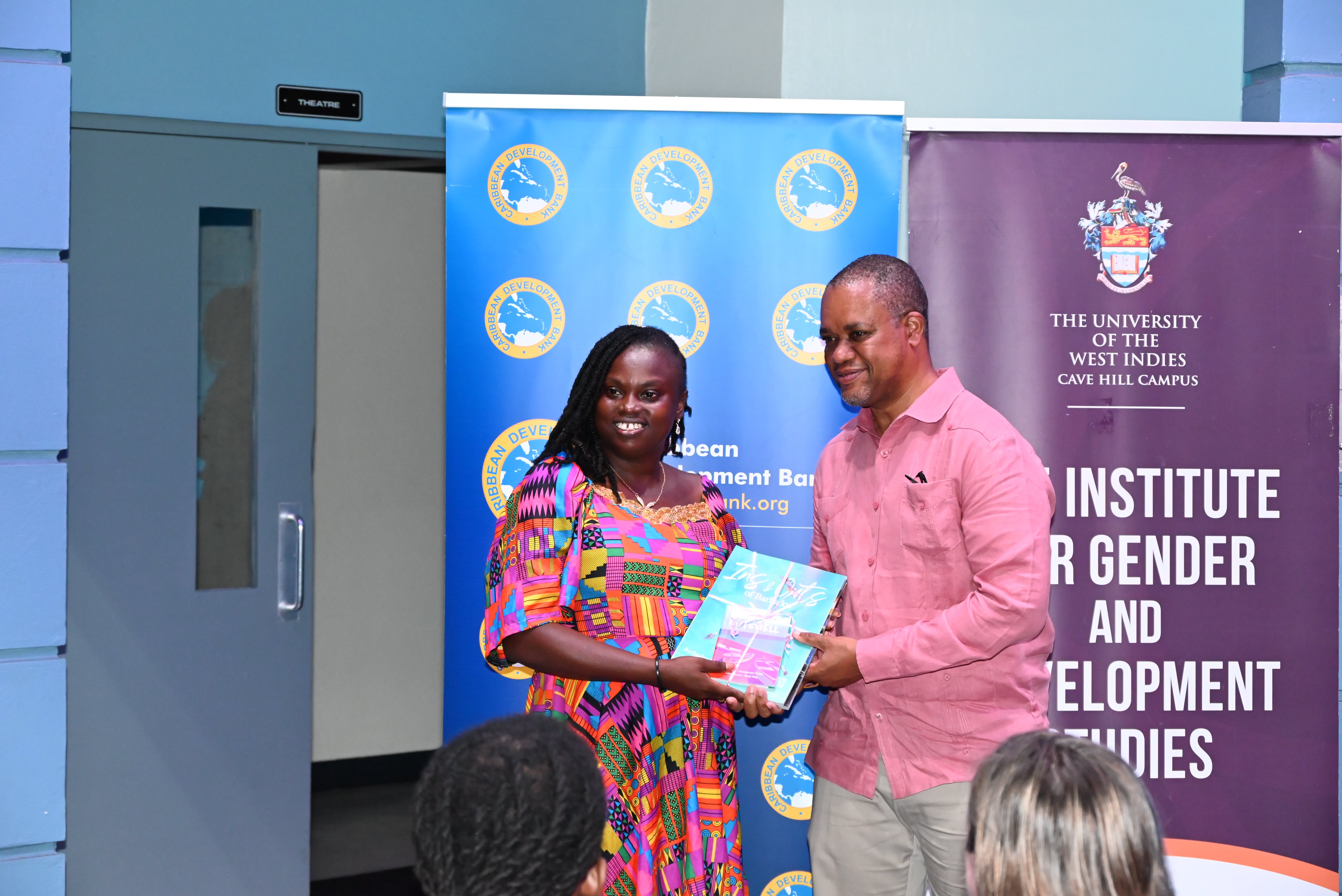
Photo caption: L. O'Reilly Lewis, Director of Projects, Caribbean Development Bank (right), presents a prize to Esther Pinas, a Caribbean Institute in Gender and Development Studies cohort member from Suriname (left).
Photo credit: UN Women Photos/Sharon Carter-Burke.