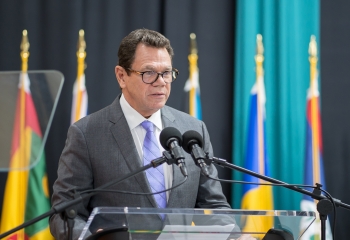
Good morning to Honourable Prime Minister(s), Ministers, Excellencies, distinguished partners, colleagues, and friends. There could not be a more fitting time or place for us to gather for the 56th Annual Meeting of the Board of Governors than here in The Bahamas.
Let me begin with appreciation and, of course, congratulations. To the Government and people of The Bahamas: thank you very much for your warm hospitality. It reflects the very best of the Caribbean spirit, welcoming, united, and forward looking.
To Prime Minister, the Honourable Philip Edward Davis: Congratulations on your historic re-election. I wish you every success in this new chapter as you continue to advance the progress and shared prosperity of the Bahamian people. Today, I invite us to reflect on how far we have come, how much we have overcome, and on what this moment is asking of us. Because history has a remarkable way of speaking to the present.
More than fifty-six years ago, during a period of profound change, Caribbean leaders gathered with a bold idea. Across the Region, countries were emerging from colonialism, building new institutions, defining new identities, and confronting an uncertain future.
In the face of these realities, those leaders understood something important. They understood that uncertainty was not a reason to retreat. It was a reason to build.
And so, they built the Caribbean Development Bank (CDB). An institution created by Caribbean people, for Caribbean people, grounded in the belief that our future would be stronger if we faced our challenges together.
It is fitting that the inaugural meeting of this institution took place right here in The Bahamas. We returned in 1980 as countries confronted difficult economic conditions. We gathered again in 2010 amid the aftermath of the Great Recession.
And now, in 2026, we meet once more in a world marked by geopolitical fragmentation, climate volatility, technological disruption, public health risks, and shrinking development finance.
Different crises. Different circumstances. But the same question. How do we build a stronger Caribbean in uncertain times?
Friends, uncertainty is not new to us. It is part of our Region’s story.
And every generation before us answered uncertainty with action.
Setting the Context and Theme
So, as I reflect on our theme for the coming week: “Forging the Caribbean’s Future: Strategic Solutions for Uncertain Times”, CDB commits that this annual meeting will ensure that we isolate challenges and issues, identify innovations and solutions, implement actions to support meaningful change and build permanent partnerships. These efforts will drive meaningful impact that will help the Bank to INNOVATE, TRANSFORM and THRIVE – elements of my vision of rebirth for the Bank.
At the Bank, we recognise that many of the challenges we face are not new, but they are being intensified by a rapidly changing global landscape.
- The impacts of climate change are now more pronounced than ever before. I had the opportunity to visit Jamaica in the aftermath of Hurricane Melissa, and what I witnessed was nothing short of gut-wrenching—communities flattened, homes gone, and a hospital barely standing. And yet, within those damaged walls, nurses and doctors pressed on, working tirelessly to care for the injured. Because that is who we are as a Region—we persevere, even in the face of devastation.
- At the same time, the changing global landscape is amplifying external shocks and geopolitical tensions, and their effects are reaching our shores with increasing speed and intensity.
We see it in rising oil prices. We feel it in supply chain disruptions that threaten our food security. Uncertainty is now the norm. - And as we become more interconnected, the pace of technological disruption is transforming all aspects of our economies and societies. It is present in rural communities where households still struggle with basic connectivity. It is evident in the growing cybersecurity threats that put our personal and national data at risk.
Yet it is this very integration that holds the greatest promise for our Region, unlocking our ability to compete on the global stage, attract world-class investment, and ultimately build resilient, dynamic societies where our young people choose not to leave, but to stay, thrive, and shape the future.
Our strength lies in our shared history. Our opportunity lies in our common challenges. And our success will be determined by how boldly we embrace regional collaboration and partnership—so that we can do better, move faster, and grow stronger, together.
What we have done since the Last Annual Meeting
Friends, since we last spoke in Brasília in 2025, we have been busy. We have approved and disbursed in excess of USD400 million to advance critical infrastructure, strengthen educational outcomes, support climate change and disaster response, and strengthen the development of the private sector across our Region.
We achieved a record USD226.7 million in climate finance commitments, while mobilising new resources through the Green Climate Fund (GCF). Notably, three CDB led GCF proposals were approved, including the first single country GCF project in The Bahamas, strengthening water security and resilience to future storms.
Across the Region, we are driving impact at scale. In partnership with Inter-American Development Bank and regional governments, we are leading a unified effort to retrofit homes in more than fifteen countries, transforming vulnerable housing into resilient shelters and protecting millions of Caribbean families from climate shocks.
At the community level, resilience continues to grow. Through the Basic Needs Trust Fund, 92 projects have been completed across nine countries, with a new USD53.6 million cycle approved.
Strategic Plan
But we are not stopping there. Our ten-year strategic plan 2026-2035 is anchored in social, economic and environmental resilience because resilience must shape every investment we make.
To translate this into action, we are focusing where it matters most:
- First, our youth. Nearly half our population is under 30, yet too many remain disconnected from opportunity. This is not just a social challenge; it is an economic one. Our strategy prioritises skills, entrepreneurship, and access to finance so that our young people can build their futures here at home.
Let me tell you about Nkrumah Fong, a young Jamaican innovator and founder of CERES Labs who is turning climate ambition into action with VECTOR 1, a pilot technology designed to reduce emissions from vehicles, ships, ports, generators, and buildings. His breakthrough was accelerated through a CDB funded regional cleantech incubator, implemented with the Caribbean Climate Innovation Centre. With targeted support, he transformed an idea into a cutting edge carbon absorption solution. VECTOR 1 shows how CDB investment in youth and innovation is driving climate resilience and green growth in the Caribbean.
- Second, stronger institutions. Development is about more than financing—it is about delivery. The real test is whether we can turn ideas into outcomes and commitments into tangible improvements in people’s lives, because citizens do not experience strategies; they experience results.
In Belize, our engagement went beyond financing. CDB supported an institutional diagnostic and governance reform programme for the Development Finance Corporation, strengthening its operations, governance, and long term sustainability. Today, DFC is a leading development finance institution in Belize, supporting private sector development through business lending, mortgage financing, and student loans.
- Third, climate action. Climate risk is not a future threat; it is a present reality. We are scaling up investments in resilient infrastructure, renewable energy, and disaster preparedness, while working with partners to unlock innovative financing to strengthen our Region’s resilience. By supporting institutions such as Caribbean Centre for Renewable Energy and Energy Efficiency and the Caribbean Disaster Emergency Management Agency , we are helping to strengthen regional coordination, technical capacity, and policy coherence, ensuring that countries are better equipped to plan, respond, and deliver at scale.
At its core, this Strategy is about people: the entrepreneur seeking opportunity, the farmer facing uncertainty, and the young person deciding where their future lies. Resilience is not built on paper; it is built in lives. As I shared last year, this is a moment of rebirth for CDB.
That is why we have developed an ambitious but practical reform programme called CDB Forward. This is the vehicle that will allow us to increase our strategic plan’s development impact. It is the bridge between vision and execution, and rests on 4 pillars - an uncompromising culture of excellence, an improved operating model, enhanced governance and accountability, and strengthened financial capacity.
CDB Forward speaks to how the Bank must change, but perhaps more importantly, to why that change matters for our citizens. The cultural aspect is about who we are as an institution. For the Bank, it means building a stronger sense of purpose, accountability, collaboration, and service. For the people we serve, a stronger culture means a Bank that listens better, works more closely with countries, and remains deeply committed to improving lives through responsive and values-driven development.
The operating model is about how we work. For the Bank, it means becoming more agile, efficient, and effective in the way we design, finance, and implement our operations. It is about reducing delays, strengthening delivery, and making sure that our systems support results. For you, our clients, this means development support that reaches you faster, projects that are better prepared and better executed, and solutions that are more closely matched to their needs.
Governance and accountability are about trust. For the Bank, this means clearer roles, stronger oversight and better decision-making. For you, it means confidence that the institution is acting with integrity, stewarding resources wisely, and remaining focused on outcomes that matter.
Financial capacity is about strength and possibility. For the Bank, it means ensuring that we have the resources, tools, and financial resilience to respond at the scale the moment demands. For the people we serve, it means greater access to financing, stronger support for resilience and growth, and a Bank that can do more to help countries confront climate risk, debt pressures, and development challenges.
Ultimately, CDB Forward will position the Bank to serve the Caribbean with greater purpose, credibility, and impact in a decade that will demand nothing less.
56th Annual Meeting
Friends of CDB, as we look ahead to this week, we recognise that in a world defined by uncertainty, we must go further. We must move from commitment to execution, because uncertainty demands strategic solutions.
This Meeting is intentionally designed not just for dialogue, but for results—building partnerships and advancing implementation. Our seminars are no longer just discussions; they are solution labs, focused on delivering practical responses to real challenges.
The William G. Demas Lecture continues to anchor our thinking—challenging us to rethink development in a rapidly changing world. This year, Justice Denys Barrow reminded us of a crucial point: strong institutions, particularly judicial systems, are fundamental to resilience, investor confidence, and inclusive growth.
We are also proud of the strong presence of youth—not as observers, but as co-creators—ensuring that solutions for the future are shaped with those who will inherit it.
Our platforms reflect this shift from ideas to action:
- The Impact Room is where strategy meets execution, advancing projects, partnerships, and private sector engagement.
- EDGE X connects innovation, technology, and development. From Dr. Rae Julien Furlonge’s work on transportation systems to our economists’ analysis of global uncertainty, these sessions focus on data-driven, forward-looking solutions.
- The Breakfast Exchange brings partners together to tackle financing and structural vulnerabilities facing SIDS, including climate and agricultural resilience.
- The President’s Chat, with leaders from CABEI and the OPEC Fund, centers on collaboration and how development institutions must evolve to respond effectively to today’s challenges.
But the true strength of this Meeting lies in its people—governments, the private sector, IFI partners, civil society, academia, and voices too often unheard. Because inclusive solutions are the only ones that endure.
Closing
Friends, the moment before us is urgent. But it is also full of possibilities. The challenges we face are real. But so too is our capacity to overcome them together. And I say this with confidence because when I look across this room, I see something far more powerful than uncertainty, I see leadership, I see partnership, I see innovation, I see determination and I see the same spirit that brought Caribbean leaders together more than fifty-six years ago. Those leaders looked beyond the crises of their moment and chose to build an institution that would serve generations they would never meet.
Today, we are the beneficiaries of that vision. Because the Caribbean has never waited for history to happen to it. We have always been at our best when we have had the courage to shape history ourselves. That was true when this Bank was established. It was true through every challenge that followed and it must be true again now.
So let us leave this Meeting with urgency. Let us leave with purpose. Let us leave with a renewed commitment to partnership and let us leave determined to build a Caribbean that is stronger, greener, more resilient, more inclusive, and more prosperous than the one we inherited. Because if those visionary leaders who founded this institution could look upon us today, I believe they would ask only one thing of us: To be as bold in our moment as they were in theirs.
Thank you.