Caribbean Leaders Call for Greater Reforms to Advance Clean Energy Transition
NASSAU, The Bahamas: Senior officials from Caribbean governments, regulators, the private sector, and development partners have issued a clear call to transform the region’s energy systems and unlock abundant renewable resources to deliver clean, affordable, reliable power. Speaking at the Caribbean Development Bank (CDB) 56th Annual Meeting of the Board of Governors in Nassau on Thursday, June 4, regional leaders delivered an unequivocal message: the region must move beyond fragmented efforts and embrace bold, coordinated inclusive action.
The call came during the seminar “Energy Transition: The Key to a More Resilient Region,” where panellists set out shared priorities for the next 12 to 24 months: bundling small national projects into investable regional portfolios, scaling up guarantees and blended finance to attract private capital, and building modern climate-resilient grids designed for a renewable future.
Panellists also elaborated on the need for regional integration, stronger technical capacity within governments, regulators, and utilities, and the meaningful inclusion of youth in developing solutions – key pillars of CDB’s 2026–2035 Strategic Plan, Transforming the Caribbean for Resilience.
The Bank’s focus on advancing clean energy security for its Borrowing Member Countries was a central theme of the session. CDB’s Director of Projects, Mr. L. O’Reilly Lewis, explained the broader impact of the support as, “If we get the energy transition right, we can preserve foreign exchange, stabilise energy costs, create green jobs, and give our businesses room to breathe and grow. CDB's 10-year strategy commits us to supporting this transition: one that is inclusive, affordable, and resilient.”
That transition, panellists agreed, hinges less on a shortage of capital than on how that capital is structured. “This is not a liquidity issue. It is an issue of investability, and that is where we must focus our attention,” said Mr. Timothy Antoine, Governor of the Eastern Caribbean Central Bank (ECCB), citing a lack of investment architecture as a key barrier to the region’s clean energy transition. Blended finance, he added, is critical to closing that gap, “We must design an investment architecture that leverages not only multilateral development banks but also commercial banks.”
Building that architecture, other panellists stressed, also means working together. Asked by seminar moderator and CDB’s Sustainable Energy Coordinator, Mrs. Charmaine Gill-Evans, how shared infrastructure and regional cooperation can boost the transition, the Green Climate Fund’s Director of the Department of Latin America and the Caribbean Region, Ms. Kristin Lang, said, “You do need to think about regional energy hubs, cross-border systems, shared planning, coordinated investment, and align system design in the region. Having isolated systems is not going to create resilience it’s going to make you more vulnerable to shocks.”
On the ground, that cooperation is already taking shape. Mrs. Toni Pratt, CEO of Bahamas Power and Light Company Limited, shared why bringing utility companies into the process has helped deliver renewable energy at scale by explaining, “We found that inviting partnerships for solar implementation, battery energy storage, and microgrids throughout the Family Islands is one of the ways that we don't have to bear that upfront cost, but we can reduce overall cost to our consumers by reducing our reliance on fossil fuels, which is primarily the highest cost that our consumers bear at this time.”
The role of reliable clean energy in driving innovation was also emphasised during the conversation. Drawing on his country’s experience in developing a 10-megawatt geothermal plant, Dominica’s Minister for Foreign Affairs, International Business, Trade and Energy, the Honourable Dr. Vince Henderson, said, “Energy must be part of integrated development plans. It is fundamental to development in the 21st century. People are excited about AI and digital transformation, but without reliable power, none of that is possible. If power systems fail, we face serious consequences.”
Youth perspectives were also integrated into the dialogue. Session co-moderator Mrs. Sorayadebie Jhagroe, a young climate advocate and member of the Bank’s Future Leaders Network from Suriname, encouraged panellists to consider how young persons can contribute to achieving regional energy security. “The future is now and we as youth are not merely beneficiaries of the energy transition, but we are an active part of shaping that,” said Mrs. Jhagroe.
Minister Henderson echoed the youth message by adding, “The key point is that investments must stand the test of time. They must include young people, not as an afterthought but as a central focus. These investments are for the next 25 to 50 years, and young people will drive that future.”
Online audiences are invited to watch the recap of “The Energy Transition: The Key to a More Resilient Region” on CDB’s YouTube Channel.
###
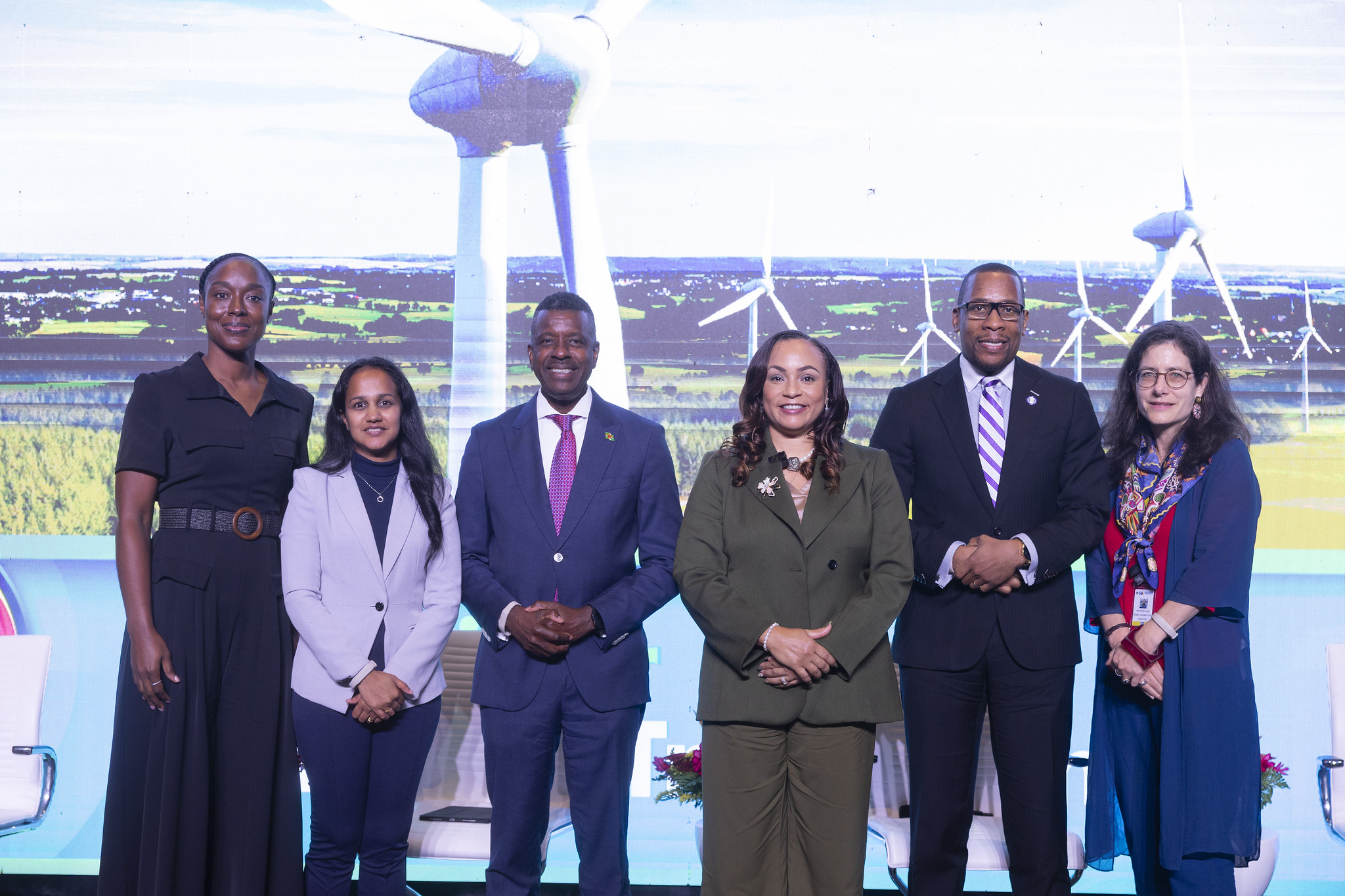
Photo caption: (L-R): “Energy Transition: The Key to a More Resilient Region” seminar moderator and Sustainable Energy Coordinator for the Caribbean Development Bank (CDB), Mrs. Chamaine Gill-Evans and seminar co-moderator and member of CDB’s Future Leaders Network from Suriname, Mrs. Sorayadebie Jhagroe, are joined by panellists Dominica Minister for Foreign Affairs, International Business, Trade and Energy, the Honourable Dr. Vince Henderson; CEO of Bahamas Power and Light Company Limited, Mrs. Toni Pratt; Governor of the Eastern Caribbean Central Bank (ECCB), Mr. Timothy Antoine; and Green Climate Fund Director of the Department of Latin America and the Caribbean Region, Ms. Kristin Lang.