
The Evaluation Policy of the Caribbean Development Bank (CDB) sets out the principles that guide a strong, independent evaluation function: supporting learning, accountability, evidence‑based decision‑making, and transparency across the Bank. Updated to reflect CDB’s core values, lessons learned since the first policy in 2011, and significant advances in global evaluation practice, the policy responds to the 2024 external peer review’s call for urgent revision. The result is a modern, forward‑looking policy aligned with internationally accepted evaluation standards.

The OIE is the custodian of the evaluation function in CDB and is responsible for commissioning and conducting independent evaluations of CDB's policies, strategies, programmes, projects, instruments, processes, and systems.
About Us
The Office of Independent Evaluation (OIE) reports to the Caribbean Development Bank (CDB) Board of Directors, through the Development Effectiveness Committee (DEC). It contributes to the Bank's development effectiveness by assessing internal processes and procedures, and providing lessons learnt and recommendations for improvement.
Our Role
OIE generates evaluation knowledge to improve programmes and processes, and promotes accountability for results. Working with qualified consultants, it gathers and analyses data and presents reports on CDB's major sectors, themes and country programmes. It also validates self-evaluations conducted by Operations.
History
The CDB has had formal guidelines for evaluation since 1992, focusing primarily on ex-post project evaluation. In 2011, the CDB assessed its evaluation function to develop a policy reflecting the then good practices among development organizations. The 2011 Evaluation Policy guided the Evaluation Function within the CDB for 14 years.
In 2025, a revised Evaluation Policy fully clarifies the structural, organisational, functional and behavioural principles of independent evaluation in CDB, while continuing to reflect the Bank's core values and incorporating lessons learned.
The guiding principles behind the Evaluation Function of CDB are: Utility, Independence, Credibility, Impartiality, Ethics, Transparency, Dissemination, Ownership and Participation, Timeliness, Professionalism and Quality.
At the heart of a thriving organisation, OIE operates independently yet interdependently - grounded in global best practice, locally adapted.
Objective
Evaluation at CDB seeks to support the Bank in achieving its purpose to: "contribute to the harmonious economic growth and development of the Member Countries in the Caribbean and to promote economic co-operation and integration among them, having special and urgent regard to the needs of the less developed Members of the region”.
Evaluation Policy, Annual Report, Workplan
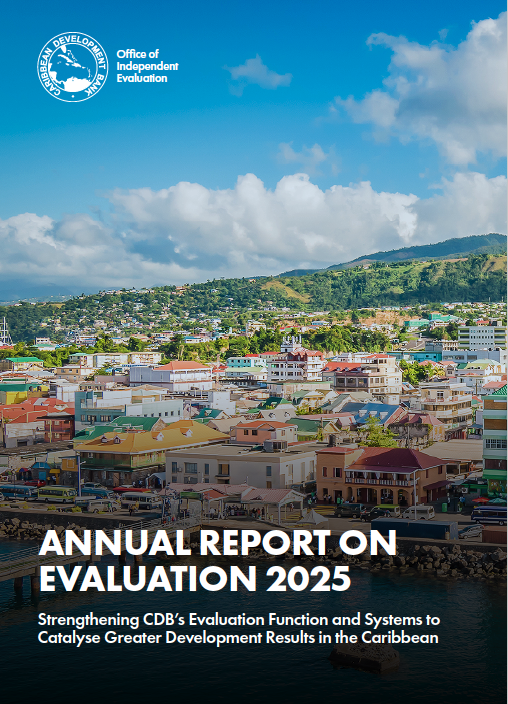
The Office of Independent Evaluation's (OIE's) Annual Report on Evaluation 2025 documents a defining year of transition and transformation for the Caribbean Development Bank's (CDB's) evaluation function.
The Work Programme encompasses the evaluative initiatives planned for the forthcoming fiscal year (2026), along with a forward-looking tentative plan for the subsequent fiscal period (2027). This document presents the adjustments to evaluation activities scheduled in the current fiscal year (2025), supported by justifications that reflect changing priorities and contexts and OIE’s new vision. The changes are also due to the completion, in 2025, of the 5-year rolling WP 2020-2025, the transition in OIE leadership during the first half of 2025, and the start of a new OIE rolling WP that, from 2026 onwards, will be in 3-year cycles to reflect the more dynamic nature of global changes. The 2026-2028 WP anticipates and strategically aligns with broader milestones, including the completion of the Sustainable Development Goals and Agenda 2030, as well as the simultaneous development and upcoming entry of the Bank into a new CBD’s Strategic Plan 2026-2035.