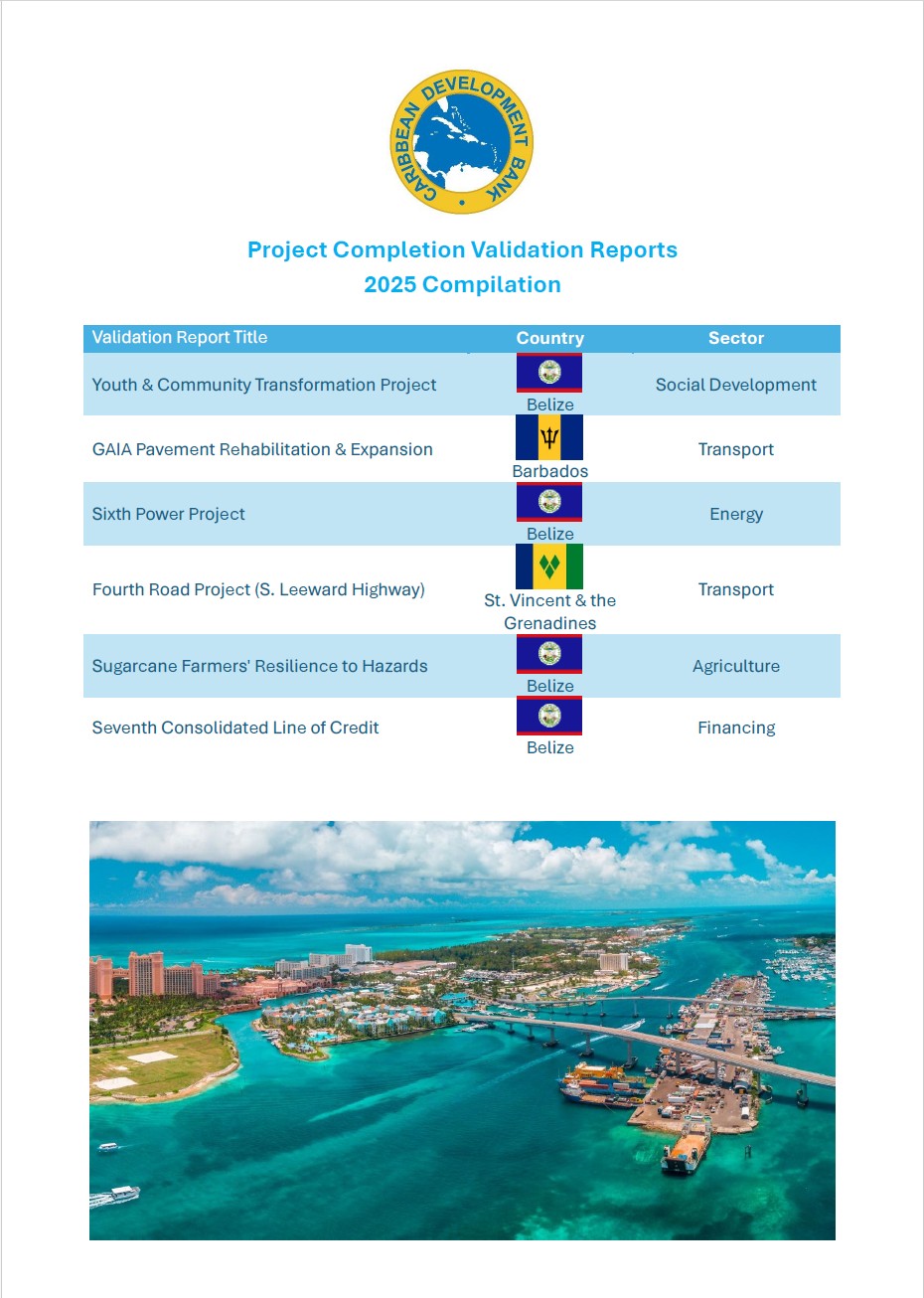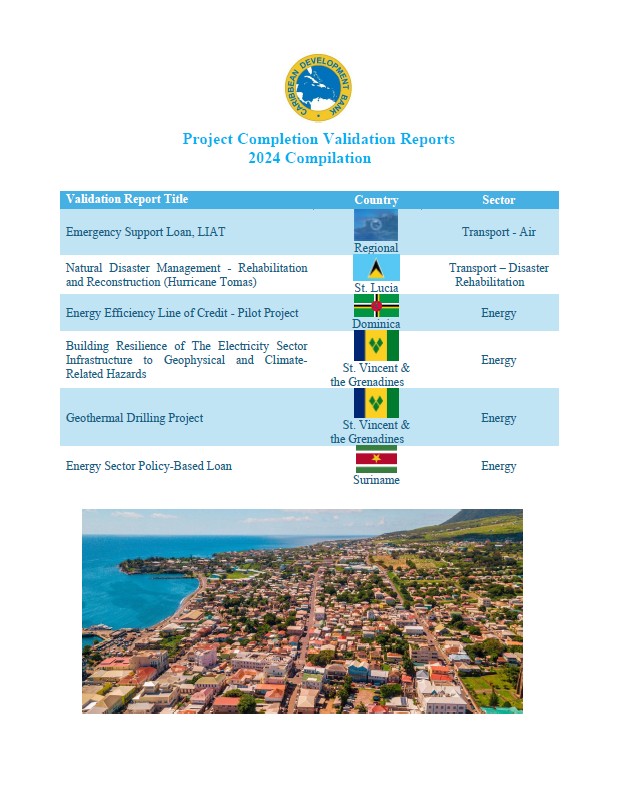
Evaluations & Resources

All OIE evaluation reports, briefs, and knowledge products are publicly available. Browse our full library, from in-depth evaluation reports and Management Response Action Plans to concise evaluation briefs and annual reports. Everything we publish is evidence-based, openly disclosed, and designed to be used.

To access the latest evaluations and resources, regularly check this page for updates.

Woman with both thumbs up

All OIE evaluation reports, briefs, and knowledge products are publicly available. Browse our full library, from in-depth evaluation reports and Management Response Action Plans to concise evaluation briefs and annual reports. Everything we publish is evidence-based, openly disclosed, and designed to be used.

To access the latest evaluations and resources, regularly check this page for updates.

SEARCH AND FILTER

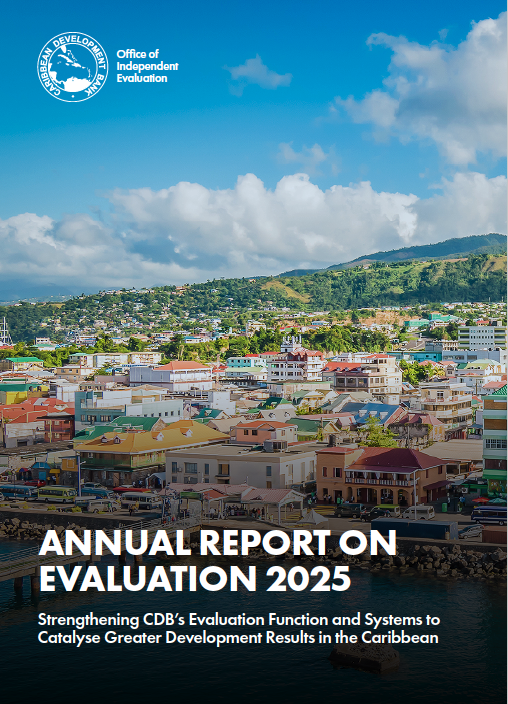
ARE 2025 thumbnail

Annual Report

Annual Report on Evaluation 2025

The Office of Independent Evaluation's (OIE's) Annual Report on Evaluation 2025 documents a defining year of transition and transformation for the Caribbean Development Bank's (CDB's) evaluation function. The report covers the renewal of CDB's Evaluation Policy - approved by the Board in December 2025 - and the development of two new operational manuals guiding independent and self-evaluation. It presents OIE's work across six interconnected streams: governance and systems, conducting evaluations, building evaluation culture and capacity, partnerships and networks, follow-up on recommendations, and communication and knowledge dissemination. Key highlights include completed country and corporate evaluations, the launch of a pilot Real-Time Evaluation in Guyana, the establishment of the inaugural Evaluation Advisory Committee, and the start of a regional capacity-building partnership with CLEAR-LAC. The report also outlines OIE's vision to 2030 and priorities for the new 2026-2028 Work Programme.

BNTF Thumbnail

Synthesis Study

Sector

Synthesis Study on Lessons Learned from the Basic Needs Trust Fund (BNTF)

The Basic Needs Trust Fund (BNTF) serves as the Caribbean Development Bank’s (CDB’s) primary poverty-reduction instrument and has demonstrated ongoing success. The BNTF program achieves its objectives through active community participation and by aligning design with national priorities, thereby supporting national development initiatives to improve access to and delivery of basic services and enhance human development outcomes in its Borrowing Member Countries (BMCs). The synthesis shows that BNTF achieved its goals through its community-based approach, which enabled people to participate in decision-making (a demand-driven approach) and used funding to build essential social structures and develop skills.The study confirms that BNTF remains highly important because it stems from community needs and delivers results. The program achieved its multiple objectives by enhancing accessibility, developing human potential, and establishing new economic opportunities, leading to improved health outcomes for Caribbean inhabitants. BNTF will achieve its maximum developmental effect through its focus on outcome-level evidence, its use of new approaches, and its refinement of particular thematic frameworks. 

Children playing in ECD setting

Evaluation Policy

2025 CDB Evaluation Policy

The Evaluation Policy of the Caribbean Development Bank (CDB) sets out the principles that guide a strong, independent evaluation function: supporting learning, accountability, evidence‑based decision‑making, and transparency across the Bank. Updated to reflect CDB’s core values, lessons learned since the first policy in 2011, and significant advances in global evaluation practice, the policy responds to the 2024 external peer review’s call for urgent revision. The result is a modern, forward‑looking policy aligned with internationally accepted evaluation standards.

TT CSPE Report cover

Evaluation Report

Country (CESE/CSPE)

Trinidad & Tobago Country Strategy and Programme Evaluation 2017-2021

This Country Strategy and Programme Evaluation (CSPE) examines the Caribbean Development Bank’s (CDB) Country Strategy and Programme (CSP) for Trinidad and Tobago for the period 2017–21; and activities implemented and designed by the Bank until 2024. The evaluation, drawing on international evaluation standards for CSPEs, uses a mixed-methods approach, combining document reviews, portfolio analysis, and stakeholder interviews, to inform the next Country Engagement Strategy (CES).

WP&B thumbnail

Strategy and Plans

OIE Work Programme and Budget 2027 to 2028

The Work Programme encompasses the evaluative initiatives planned for the forthcoming fiscal year (2026), along with a forward-looking tentative plan for the subsequent fiscal period (2027). This document presents the adjustments to evaluation activities scheduled in the current fiscal year (2025), supported by justifications that reflect changing priorities and contexts and OIE’s new vision. The changes are also due to the completion, in 2025, of the 5-year rolling WP 2020-2025, the transition in OIE leadership during the first half of 2025, and the start of a new OIE rolling WP that, from 2026 onwards, will be in 3-year cycles to reflect the more dynamic nature of global changes. The 2026-2028 WP anticipates and strategically aligns with broader milestones, including the completion of the Sustainable Development Goals and Agenda 2030, as well as the simultaneous development and upcoming entry of the Bank into a new CBD’s Strategic Plan 2026-2035.

Water Sector Evaluation Thumbnail

Financial Services

Evaluation Report

Sector

Evaluation of the Caribbean Development Bank’s Work in the Water Sector (2017-23)

This independent evaluation provides an assessment of the Bank’s work in the water (including wastewater) sector over the six-year period (2017 to 2023). The evaluation focuses on four focal areas: a) Water supply (WS); b) Sanitation (SAN); c) Education and training in water supply and sanitation (ET); and d) Agricultural Water Resources (AG). It reviews operational management processes, coordination within the Bank, and the beneficiaries' perspectives to identify challenges, best practices, and the value of projects. The evaluation's findings aim to offer insights to inform the Bank's management and Board of Directors about future interventions and the renewal of the Water Sector Policy and Strategy. These findings are also relevant to external stakeholders, including national governments, water sector agencies, and community-based organisations.

Peer Review Report Cover

Peer Review of the Evaluation Function of the Caribbean Development Bank

This peer review examines the Caribbean Development Bank’s (CDB) evaluation function, which consists of the self-evaluation of the operations and the independent evaluation conducted by the Office of Independent Evaluation (OIE). The main purpose of this review is to provide insight for the renewal of the 2011 Evaluation Policy, as well as to enhance the confidence in and use of evaluations by the Board and Senior Management, with the goal of strengthening the effectiveness, efficiency, and governance of the institution. This review was done using a mixed-methods approach that builds on good-practice principles established by the Multilateral Development Banks’ (MDBs) Evaluation Cooperation Group (ECG), which emphasize independence, credibility, and utility.

Multicycle Evaluation Thumbnail

Evaluation Report

Corporate

Multicycle Evaluation of the Unified Special Development Fund (SDF) Eighth and Ninth Cycles (2013–16 and 2017–20)

This report presents the findings, conclusions, and recommendations from the Multicycle Evaluation of the Unified Special Development Fund (SDF), specifically focusing on the Eighth and Ninth Cycles (SDF 8 and SDF 9). It was commissioned by the Caribbean Development Bank’s (CDB) Office of Independent Evaluation (OIE) and conducted by Technopolis Group. The evaluation aimed to identify achievements, challenges, and recommendations to improve future SDF cycles, particularly SDF 11, the replenishment phase of which is scheduled to begin in March 2024. To this end, the evaluation addresses five key criteria: Relevance, Coherence, Efficiency, Effectiveness, and sustainability, following OECD DAC guidelines.SDF 8 (2013–2016) aimed to address development challenges, focusing on inclusive and sustainable growth, environmental sustainability and climate change, citizen security, and regional cooperation and integration (RCI). The overall programme level was USD$348 million.SDF 9 (2017–2020) aligned with new international development frameworks, emphasising support for Sustainable Development Goals (SDG) targets, climate resilience, and regional cooperation. Major cross-cutting areas included good governance, environmental sustainability, and gender equality. The programme level for SDF 9 was USD355 million.Key differences between SDF 8 and 9 include the full incorporation of SDGs into SDF 9’s poverty-reduction principles, structural reforms in the Basic Needs Trust Fund (BNTF), and initiatives such as the opening of the Haiti Country Office and the regional focal point for RCI initiatives.

Bahamas CSPE Thumbnail

Evaluation Report

Country (CESE/CSPE)

The Bahamas Country Strategy and Programme Evaluation 2018-2022

Country Strategy Paper (CSP) period (2018-22), including major projects approved under the previous CSP period (2024-17) still under implementation.

ESIA Thumbnail

Evaluation Report

Corporate

Evaluation of the Caribbean Development Bank’s Environmental and Social Review Procedures (2014- 22)

The current version of the Caribbean Development Bank’s (CDB) Environmental and Social Review Procedures (ESRP) document was approved in 2014 and built on earlier experience in the application of the Bank’s Environmental Review Guidelines (1994) and the Guidelines for the Social Analysis of Projects (2004). The ESRP outlines how CDB, within its mandate and operations, ensures that environmental and social risks are managed. The ESRP include eight environmental and social performance requirements (PRs) to:Optimise decision-making with respect to environmental and social impacts, and risks to anticipate, avoid, mitigate, and/or compensate for adverse project impacts on the environment and affected people and communities. Assist Borrowing Member Countries (BMCs) to build capacity and strengthen their institutions and governance systems to manage environmental and social risks effectively. Provide staff, BMCs, and other development partners with a clear understanding of CDB’s requirements, and procedures, accountabilities for managing environmental and social risks in its operations. The Environmental Sustainability Unit (ESU) is responsible for updating and revising the ESRP, developing other policies/procedures, familiarising and training staff, and providing general guidance. The ESU and the Social Sector Division (SSD) are also involved in project work, coordinating project appraisal and supervision, and providing technical inputs.