Evaluations & Resources

All OIE evaluation reports, briefs, and knowledge products are publicly available. Browse our full library, from in-depth evaluation reports and Management Response Action Plans to concise evaluation briefs and annual reports. Everything we publish is evidence-based, openly disclosed, and designed to be used.

To access the latest evaluations and resources, regularly check this page for updates.

Woman with both thumbs up

All OIE evaluation reports, briefs, and knowledge products are publicly available. Browse our full library, from in-depth evaluation reports and Management Response Action Plans to concise evaluation briefs and annual reports. Everything we publish is evidence-based, openly disclosed, and designed to be used.

To access the latest evaluations and resources, regularly check this page for updates.

SEARCH AND FILTER

OIE WP 2017 Cover

Strategy and Plans

OIE Work Programme 2017-2020

This five year plan for evaluation at the Caribbean Development Bank (CDB) is articulated in three parts. Part One examines the context for evaluation at the Bank, including its Evaluation Policy, strategic planning documents, policies and strategies, and co-investment partners. Part Two surveys the broader Multilateral Development Bank (MDB) context of which CDB is a part and highlights the particular trends in MDB policies and evaluation approaches which this plan should take account of. Part Three sets out indicative plans for evaluation at CDB over the 2018 to 2022 period; the considerations that have informed these evaluation choices; the expected phasing and resource requirements; and some important enabling activities such as knowledge management and capacity building.It is important to note that this is conceived as a rolling plan, to be refreshed at least bi-annually, and in particular to take account of any significant changes in CDB’s strategic environment (for example a new Strategic Plan and/or Special Development Fund [SDF] Contributors’ Agreement).

Third Road SVG

Transportation

Project Completion Validation Report

Third Road Project - St. Vincent & the Grenadines (2018)

The Government of St. Vincent and the Grenadines (GSVG) recognises that investment in the transport sector is critical to growth and development, particularly in support of agriculture, tourism and services. In 2000, with technical assistance from the European Union (EU), consultants were contracted to investigate the condition of the 55 kilometers (km) Windward Highway (WH), the longest of the three main highways which runs along the eastern coast of St. Vincent, and to make recommendations for a programme of rehabilitation or improvement of the road. The consultants recommended that the work be carried out in three phases. The Government decided to initiate Phase 1 - total reconstruction of WH from Diamond to Georgetown. In June 2002, GSVG requested financial assistance from the Caribbean Development Bank (CDB) for joint financing along with the EU, for the reconstruction of approximately 23 km and the rehabilitation of the existing structures, including bridges. A loan of USD10.581 mn was approved in response to this request in December 2002. During implementation the Government announced a change in policy with regard to air transportation and prioritised the construction of a new international airport at Argyle. It was realised that additional financing was needed to the realign a section of the WH which would be affected by the new airport. The project was re-scoped and an additional loan of USD5.2 mn granted in 2007.

8th Consolidated LOC

Food Security

Project Completion Validation Report

Eighth Consolidated Line of Credit - Dominica (2017)

In December 2009, the Caribbean Development Bank (CDB) approved a loan in the amount of USD8 million (mn) to the Dominica Agricultural Industrial Development Bank (DAIDB) [comprising USD7.5 mn from the Bank’s Ordinary Capital Resources (OCR), and USD0.5 mn from its Special Funds Resources (SFR)], to assist in the continuation of the lending programme of DAIDB in the productive and housing sectors, and for student loans (the Project). The primary objectives of DAIDB, which was established in 1971, are to promote, influence and mobilise funds for economic development in the Commonwealth of Dominica. CDB has been the primary source of long term funding for DAIDB. The Financial Services Unit (FSU) of the Ministry of Finance, which became effective on January 1, 2009, is responsible for supervising DAID’s operations but due to capacity constraints, had not yet begun as of the end of 2009. DAIDB had been dogged by financial performance challenges, but by the end of Financial Year (FY) 2009 DAIDB’s new strategic focus and ongoing restructuring efforts were yielding improvements in key indicators: non-performing loans (NPLs), growth in assets, profitability, liquidity gap, approvals, debt to equity ratio, provisioning for loan loss, and return on assets.

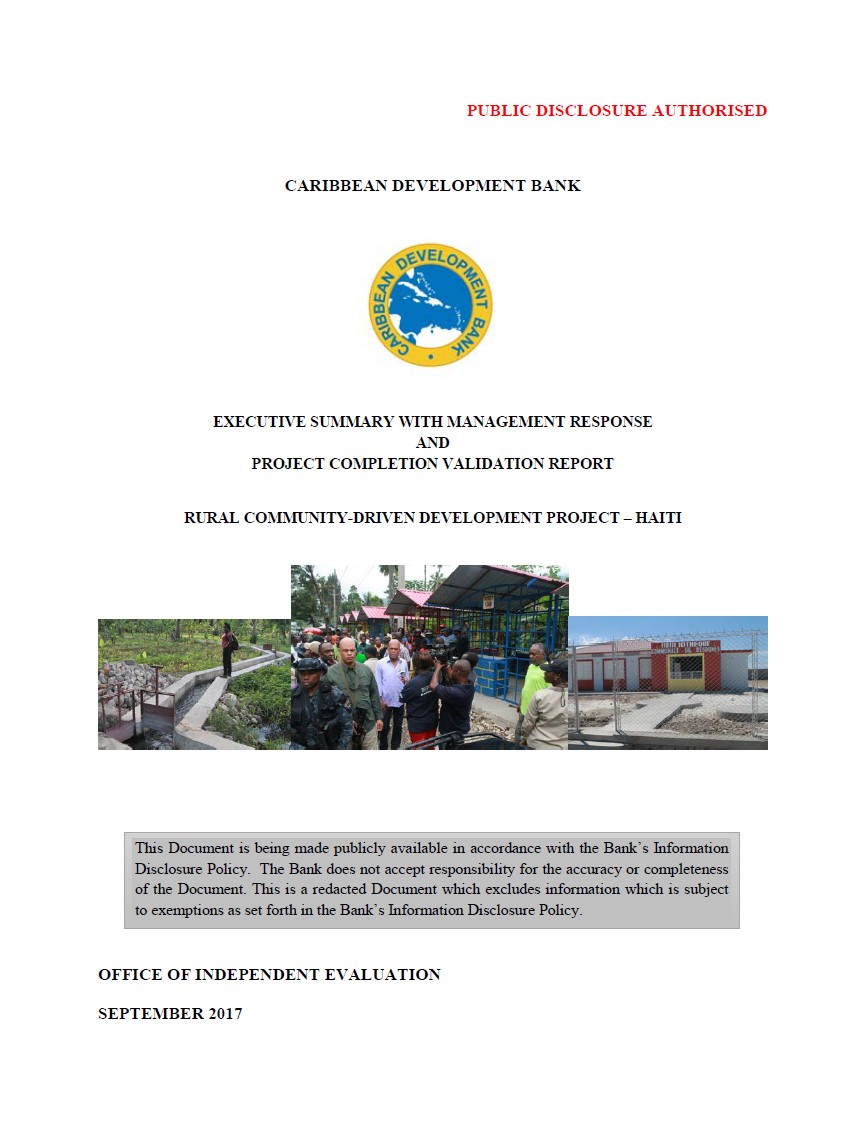
Rural Community Project Haiti

Private Sector Development

Project Completion Validation Report

Rural Community-driven Development Project - Haiti (2017)

Political instability and natural hazard events have devastated Haiti’s economy and weakened state institutions. In an effort to break the cycle of poverty and social exclusion which for decades plagued Haiti’s rural communities, the Government of the Republic of Haiti (GOH) in 2004 initiated, with funds of the World Bank (WB) Post-Conflict Facility, a One million dollar ($1 mn) Rural Community Development pilot project. Following the success of the pilot operation, GOH obtained, in 2005, a grant equivalent to$38 mn from WB and began the implementation of the Community Participation Development Project (PRODEP) Programme in 2006. Since then WB has provided two rounds of additional financing in response to increased pressures on rural communities associated with an influx of urban residents after the January 2010 earthquake. PRODEP was implemented in 59 (out of 140) municipalities in all Departments of Haiti and proved to be an effective mechanism for building social inclusion and social capital, community participation, transparency, trust and public/private partnerships at the local level. The programme’s mechanism also efficiently transferred resources to local communities and reduced poverty by improving basic social and economic infrastructure and services, through the creation of income-generating opportunities for rural residents. The Caribbean Development Bank (CDB) chose to add its financing to the PRODEP initiative in December 2011. It provides funding for rural investments (sub-projects) and for the capacity building of Community-based organisations (CBOs) and Community Development Councils (CADECs) with a focus on rural communities in northern Haiti. The project targeted poor rural communities in 31 municipalities of 5 Departments, defined by the country’s 2008 poverty map as the poorest in the country. Most of the municipalities in these Departments, which were also located away from major urban centres, had limited access to markets because of poor road and market infrastructure and suffered considerable damage form storms and hurricanes.

MTE BNTF 7-8 COVER

Poverty Alleviation

Evaluation Report

Corporate

Mid-Term Evaluation of the Basic Needs Trust Fund 7 and 8

Under the Basic Needs Trust Fund Sixth Programme (BNTF 6) approved by the Caribbean Development Bank (CDB) Board of Directors (BOD) at its Two Hundred and Thirty-Second Meeting held on July 24, 2008 pursuant to Paper BD70/08, CDB was required to engage independent consultants to complete the Programme Closing Report (PCR). Additionally, under the terms of the Basic Needs Trust Fund Seventh and Eighth Programmes approved by BOD at its Two Hundred and Fifty-Third and Two Hundred and Sixty-Fourth Meetings held on October 23, 2012 and December 11, 2014 pursuant to Paper BD101/12 and BD83/14 respectively, CDB was required to engage independent consultants to conduct a composite Mid-Term Evaluation (MTE) of BNTF 7 and 8. The BNTF 7 Paper stated that a MTE will be completed within two years of satisfaction of conditions precedent of the Grant Agreements. BNTF 8 Paper stated that the MTE would be done simultaneously with BNTF 7.

Managing for Sustainability cover

Synthesis Study

Corporate

Synthesis Report - Managing for Sustainability

This study examined project sustainability at the Caribbean Development Bank (CDB) by reviewing evaluation evidence and good practice literature from CDB and other development organisations; and suggests practical guidance on “managing for sustainability” and entry points for future action.The primary objectives were to:(a) develop an understanding of the conceptual frameworks and procedures used by other development agencies to assess and manage for project sustainability;(b) assess the sustainability of projects financed by CDB and identify the major factors that influence project sustainability;(c) identify the lessons learned and recommendations developed by other international development agencies to improve project sustainability; and(d) recommend a simple conceptual framework and procedures to facilitate the Bank’s efforts in managing for project sustainability.

External Review OIE Cover

Strategy and Plans

External Review of OIE 2017

In December 2011, the Caribbean Development Bank (CDB) agreed a comprehensive Evaluation Policy (December 2011) setting out the aim and objectives and guiding principles for CDB’s evaluation system. The Policy provides for the establishment of the Office of Independent Evaluation (OIE).In line with the Evaluation Cooperation Group’s (ECG) good practice standards, in 2015 CDB’s Oversight and Assurance Committee (OAC) endorsed an external review of CDB’s OIE. The intention is to highlight the factors that help or hinder OIE’s independence and performance in order to identify where improvements could be made.CDB has also taken many, other important steps towards updating management practices in line with other multilateral development banks (MDBs). However, the introduction of several innovations in parallel requires coordination and a shift in working practices and thinking. There is also the need to engage in different types of evaluation; evaluations that take into account cross-cutting themes and different levels of complexity. As such, whilst this Review particularly focused on CDB’s OIE, it recognises that OIE’s work and utility depend to a large degree on the development of other management practices and the degree to which evaluation is able to effectively link into their work. As such, to a limited degree, the Review took into account OIE’s linkage to other management practices.

SDF Cycle 6 & 7 Cover

Financial Services

Evaluation Report

Corporate

Multicycle Evaluation of the Unified Special Development Fund Sixth and Seventh Cycles 2005-2012

This report presents the findings, conclusions and recommendations of the evaluation of the Sixth and Seventh Cycles of the Special Development Fund (Unified) of CDB, covering the period 2005 - 2012.The evaluation assessed the utilisation of SDF6 and SDF7 resources based on the criteria of Relevance, Strategic Positioning and Responsiveness; Effectiveness; Efficiency; and Sustainability; as well as Results Based Management and Monitoring and Evaluation. Gender and the Environment are analysed as Cross-Cutting Issues.The evaluation is intended to provide evidence to improve the selection, design, preparation and implementation of SDF-funded interventions; increase the value-added by CDB in addressing its overarching mission of systematic poverty reduction in BMCs; and enhance the coherence, integration and alignment in meeting the CMDGs, including Development Effectiveness, and other strategic development objectives beyond 2015.The report provides 8 recommendations.

Student Loan Scheme GRE

Education

Project Completion Validation Report

Student Loan Scheme - Grenada (2016)

The Grenada Development Bank (GDB) has been involved with CDB’s Student’s Loan Scheme (SLS) programme for over 15 years.  In July 2001, GDB submitted an application for funds to finance its student loan programme. Following discussions between the Government of Grenada (GOGR), GDB and CDB, concerning the performance of GDB, and negotiations with GOGR, the Board of Directors (BOD) of CDB approved a loan October 10, 2002 to GOGR not exceeding the equivalent of 3.548 million (mn) United States dollars (USD3.548 mn). The loan comprised USD3 mn from CDB’s Ordinary Capital Resources (OCR) and USD0.548 mn from CDB’s Special Funds Resources. USD3 mn was to be used for the traditional SLS. USD0.5 mn or 14 per cent (%) of the total funds were designated to provide educational loans to students from poor and vulnerable households who satisfied the educational criteria but not the financial criteria of the SLS programme. Grenada is a tri-island state with a population estimated at 101,000. A labour survey done in October 2014 year showed a drop in unemployment rate from 32.5% in 2013 to 28.9% in 2014. However, the survey also showed that the highest unemployment rate was among persons between the ages of 15 to 24. CDB assessed that GDB needed institutional strengthening and strategic planning to improve its competitiveness.  A component of the loan included Technical Assistance (TA) to facilitate the preparation of a strategic plan.  It was also a condition of the loan that all posts of managerial and auditing functions be held by persons whose qualifications and experience are acceptable to CDB.

PBL Barbados thumbnail

Private Sector Development

Project Completion Validation Report

Policy Based Loan - Barbados (2016)

The post-2008 global economic and financial crisis exacerbated Barbados’ fiscal position which was already tenuous. The economy contracted in 2008, 2009 and 2010 due to declines in the key economic sectors. The crisis also exacerbated the country’s fiscal deficit which had already started to increase since 2005 on the back of a rapid expansion in public expenditure. In 2009, the economic downturn further restricted revenue intake, but necessitated counter-cyclical spending, exacerbating the already weak fiscal position of Central Government (CG). CG’s debt-to Gross Domestic Product (GDP) ratio had been on a steady increase, especially since 2007 given the fiscal deterioration and an increase in contingent liabilities. Meanwhile, interest payments as a ratio of total revenues increased. Barbados’ foreign currency bond rating had been downgraded by two international rating agencies in June and November 2009.