This document presents a synthesis of the main findings and lessons learned from evaluations completed in 2025 and published in early 2026, as well as from Project Completion Validation Reviews (PCVRs) conducted between 2023 and 2025. Together, these sources provide a consolidated view of the evidence emerging from the Caribbean Development Bank's recent evaluation portfolio.The evaluations and PCVRs offer important insights into what is working well, where challenges persist, and what lessons can be drawn to strengthen future programming. They provide evidence for the Bank, its Borrowing Member Countries (BMCs), and the Board of Directors to inform decision-making, enhance development effectiveness, and strengthen the design and implementation of future interventions.
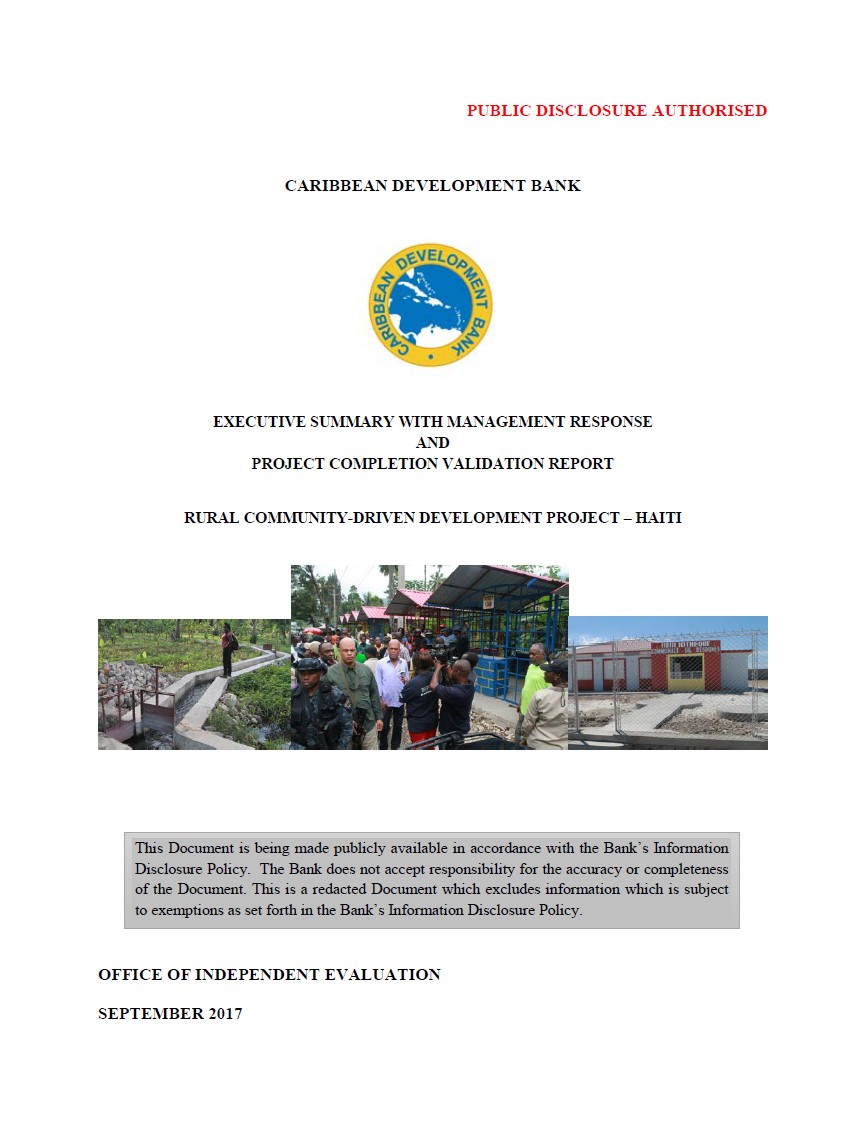
Rural Community-driven Development Project - Haiti (2017)
Private Sector Development
Project Completion Validation Report
Complete
Haiti
Summary
Political instability and natural hazard events have devastated Haiti’s economy and weakened state institutions. In an effort to break the cycle of poverty and social exclusion which for decades plagued Haiti’s rural communities, the Government of the Republic of Haiti (GOH) in 2004 initiated, with funds of the World Bank (WB) Post-Conflict Facility, a One million dollar ($1 mn) Rural Community Development pilot project. Following the success of the pilot operation, GOH obtained, in 2005, a grant equivalent to$38 mn from WB and began the implementation of the Community Participation Development Project (PRODEP) Programme in 2006. Since then WB has provided two rounds of additional financing in response to increased pressures on rural communities associated with an influx of urban residents after the January 2010 earthquake. PRODEP was implemented in 59 (out of 140) municipalities in all Departments of Haiti and proved to be an effective mechanism for building social inclusion and social capital, community participation, transparency, trust and public/private partnerships at the local level. The programme’s mechanism also efficiently transferred resources to local communities and reduced poverty by improving basic social and economic infrastructure and services, through the creation of income-generating opportunities for rural residents. The Caribbean Development Bank (CDB) chose to add its financing to the PRODEP initiative in December 2011. It provides funding for rural investments (sub-projects) and for the capacity building of Community-based organisations (CBOs) and Community Development Councils (CADECs) with a focus on rural communities in northern Haiti. The project targeted poor rural communities in 31 municipalities of 5 Departments, defined by the country’s 2008 poverty map as the poorest in the country. Most of the municipalities in these Departments, which were also located away from major urban centres, had limited access to markets because of poor road and market infrastructure and suffered considerable damage form storms and hurricanes.