This document presents a synthesis of the main findings and lessons learned from evaluations completed in 2025 and published in early 2026, as well as from Project Completion Validation Reviews (PCVRs) conducted between 2023 and 2025. Together, these sources provide a consolidated view of the evidence emerging from the Caribbean Development Bank's recent evaluation portfolio.The evaluations and PCVRs offer important insights into what is working well, where challenges persist, and what lessons can be drawn to strengthen future programming. They provide evidence for the Bank, its Borrowing Member Countries (BMCs), and the Board of Directors to inform decision-making, enhance development effectiveness, and strengthen the design and implementation of future interventions.
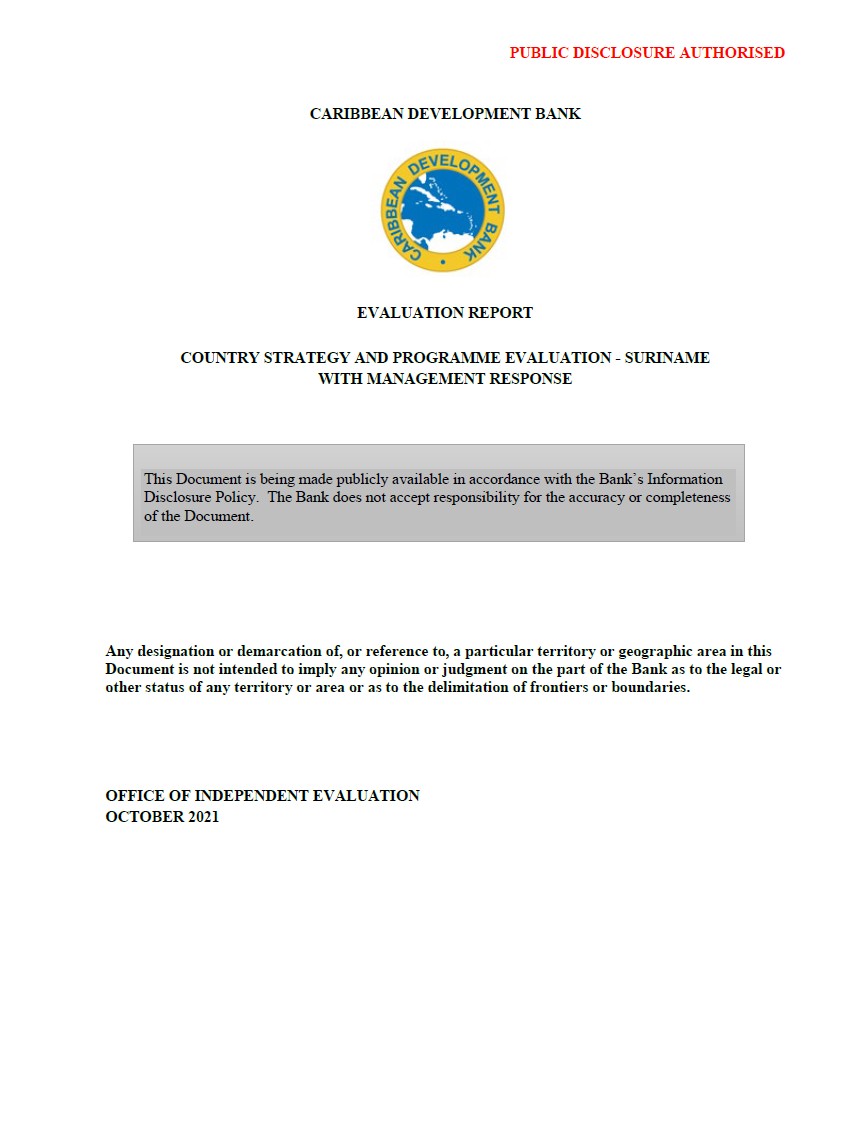
Suriname Country Strategy and Programme Evaluation
Financial Services
Evaluation Report
Country (CESE/CSPE)
Complete
Suriname
Management Response
Yes
Summary
This evaluation is the first by the Office of Independent Evaluation of the Caribbean Development Bank’s (CDB) Country Strategy and Programme in Suriname. It covers the Country Strategy Paper (CSP) (2014-18) and more recent developments up to 2020, including the first months of the new government.Suriname is the newest borrowing member of CDB, having joined in 2013. At that time, it was seen as a country which had made significant development strides in a relatively short time frame, with an expectation of anchoring growth on a platform of deep structural reforms. Bank membership offered Suriname a means of furthering its economic integration in the Region, while for CDB, developing a new programme in Suriname offered a route to expanding its borrowing membership and diversifying its loan portfolio in what was then a relatively benign credit risk environment.This positive starting point was not sustained for long. Soon after the CSP was approved, the economic situation deteriorated sharply. In 2015-16, there was a sharp recession, and Suriname needed support from the International Monetary Fund (IMF), as well as CDB and the Inter-American Development Bank (IDB). The government at the time had limited success in delivering on key reforms such as reducing fuel subsidies. The new government which came in during 2020 is now seeking to address economic challenges exacerbated by COVID-19, again requiring IMF support.