Tuesday
March
03
2026
Time
10:00 AM
Time zone
AST

Location
Frank Collymore Hall,
Central Bank of Barbados,
Spry Street,
Bridgetown, St. Michael
Watch LIVE
Events

2026 Annual News Conference

Feb 25, 2026


CDB’s Annual News Conference took place on Tuesday, March 3, 2026 at 10:00 a.m. (AST) at the Frank Collymore Hall, Central Bank of Barbados, Spry Street, Bridgetown, St. Michael.

Speakers

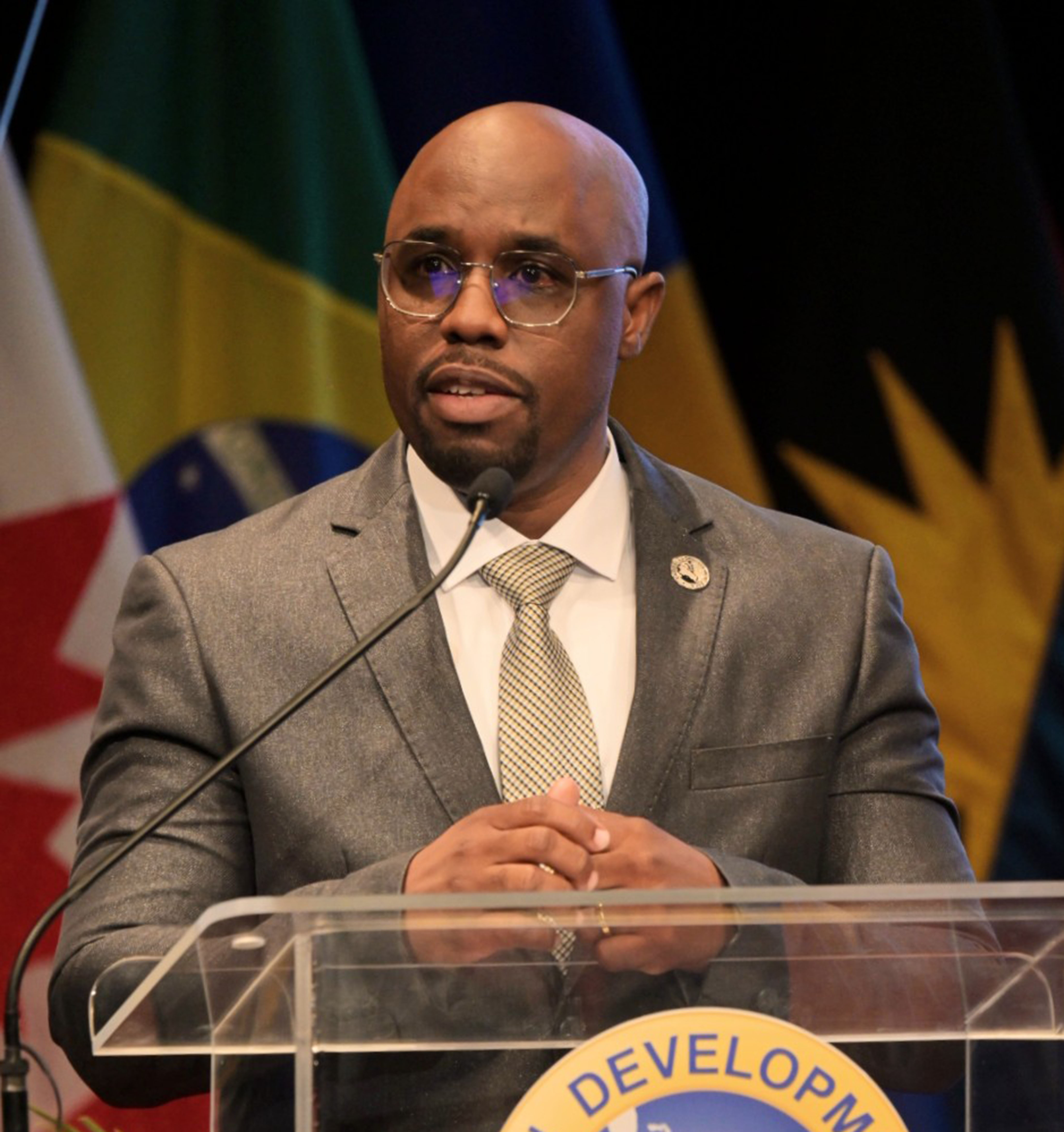
  • Mr. Daniel M. Best, President
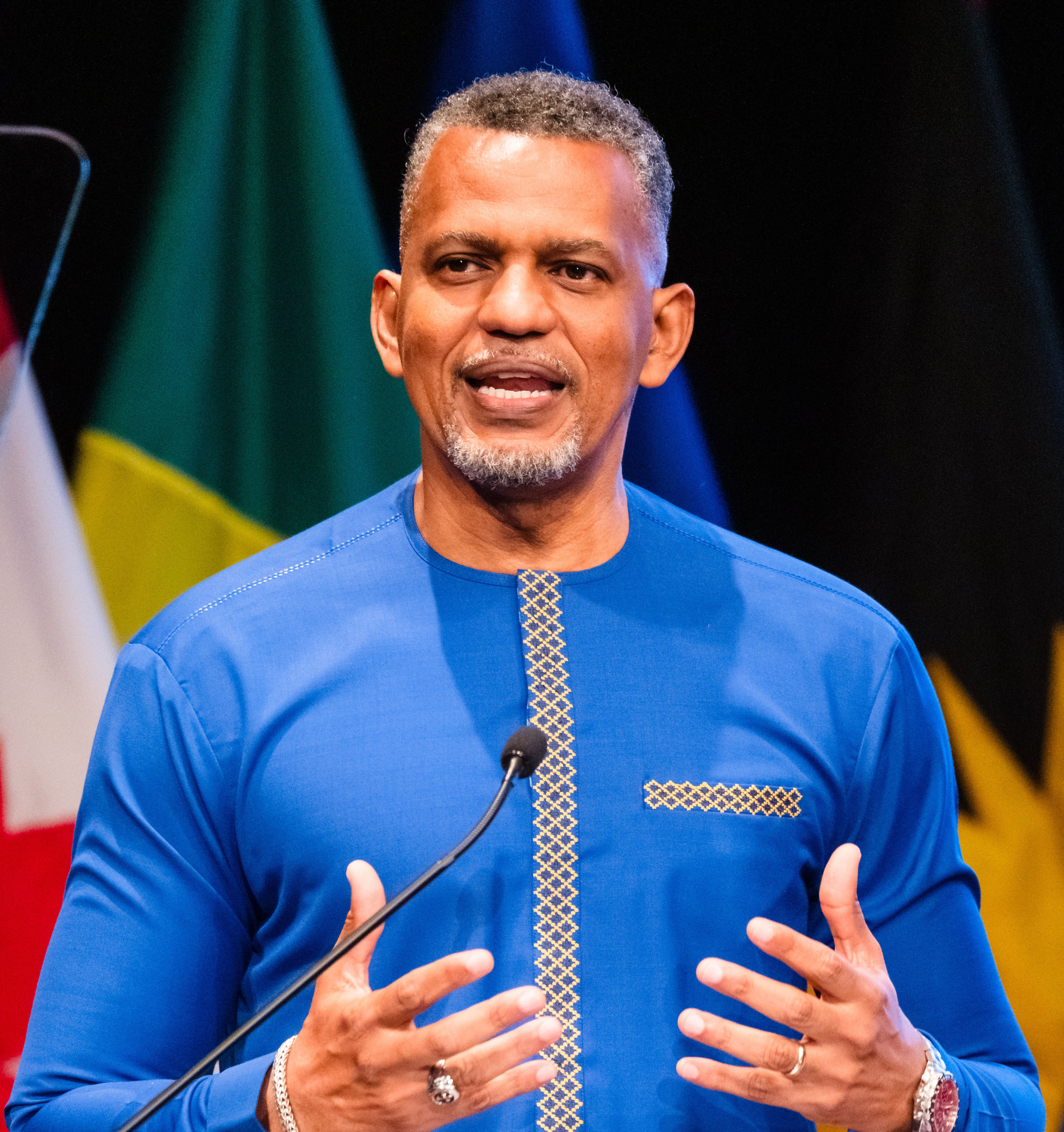
  • Mr. Jason Cotton, Deputy Director (Ag.), Economics Department
  • Mr. L. O'Reilly Lewis, Director of Projects
  • Ms. Valerie Isaac, Division Chief, Environmental Sustainability

Focal Areas

  • The President's vision for CDB and the role of the Bank in driving economic growth across the Region in 2026
  • A review of the 2025 regional economic performance and the forecast for 2026
    Highlights of the Bank’s projects in 2025 and a preview of planned projects and expected outcomes for 2026
  • The Bank’s climate and environmental priorities for 2026

Promotional graphic for the Caribbean Development Bank’s 2026 Annual News Conference on March 3, featuring an adult and child reading together.

Agenda

Welcome and Introductions  
News Conference Chair
Ms. Camille Taylor, Head, Corporate Communications 

Building Tomorrow's Caribbean: A Transformative Agenda for Regional Resilience
Mr. Daniel M. Best, President  

An overview of the Bank’s ten‑year vision and approved Strategic Plan, outlining an accelerated path of transformation for CDB.

Driving Growth: 2025 Outcomes and 2026 Outlook  
Mr. Jason Cotton, Deputy Director of Economics (Ag)

A review of the Region’s economic performance in 2025 and an outline of projections for 2026 with an assessment of the implications in the pursuit of prosperity.

Delivering Impact: Project Performance and Strategic Priorities 
Mr. L. O’Reilly Lewis, Director of Projects

An outline of how the Bank’s operations in 2025 and priorities for 2026 positively impact the Region’s economies and societies.

Countering Crisis: Accelerating Climate Action for Resilience   
Ms. Valerie Isaac, Division Chief, Environmental Sustainability  

A snapshot of how CDB is scaling investments, strengthening institutional capacity, and driving transformational, climate‑smart solutions that protect lives and livelihoods.

Questions and Answers

Thank You and Closing

Speeches

Colleagues and friends, good morning.

Today I will speak about where we stand and the future unfolding before us.

We are living through a structural shift defined by heightened geopolitical tensions, technological acceleration, climate volatility, and reconfigured global supply chains. These forces are reshaping how countries grow, compete, and secure their futures.

For the Caribbean, they converge into what I have called the decade of decision.

Will we become architects of our own resilience, or remain exposed to external shocks in a world that is increasingly selective and unforgiving?

Even before recent turbulence intensified, we projected that between 2024 and 2033, the Caribbean would require a Gross Financing Need of US$65.2 billion to prevent stagnation.

Achieving true resilience — climate adaptation, stronger infrastructure, and fiscal buffers — could double that figure. Add inevitable external shocks and higher growth ambitions, and the need escalates further.

Our region has made measurable strides toward the Sustainable Development Goals, but in some areas momentum has stalled, in others, reversed. At the current pace, 2030 will pass before we meet them.

The decade ahead cannot be financed or governed at yesterday's scale. The decisions we take today will ultimately determine whether 20 million Caribbean futures are protected or placed at risk.

What does this new era demand of the Caribbean Development Bank?  Do we operate with an outdated model or scale for a more complex and volatile era?

We have boldly chosen to scale.

Last year, I called for a Rebirth of this institution. That commitment is now in motion. In February, our Board approved the Strategic Plan for 2026–2035, providing a clear mandate that aligns the institution for the decade ahead.

This Plan is our North Star.  It is built on rigorous scenario planning and stress-tested against multiple futures, so we remain agile and prepared. It is anchored in an integrated resilience framework built on three interconnected pillars.

First, Social Resilience. We are strengthening our people’s ability to withstand shocks and still advance. Poverty, inequality, gaps in education and healthcare, natural hazards, youth unemployment, and migration continue to strain Caribbean households.

Our focus is on ensuring reliable access to essential services; reducing extreme poverty; and delivering social protection that is responsive, inclusive and grounded in dignity.

Second, Economic Resilience. For us, economic resilience means supporting our countries so they can absorb multiple shocks while sustaining inclusive growth.

We are shaping a more diversified, competitive Caribbean powered by climate-resilient infrastructure, strong fiscal systems, digital connectivity, secure food systems, a vibrant cultural sector, and a private sector driving greener, innovation-led growth.

Third is Environmental Resilience. In this region, environmental resilience is existential. It means strengthening our capacity to thrive, while protecting our people, economies, and ecosystems from escalating climate and disaster risks.

So, we are advancing green opportunities and a nature-positive, climate-resilient, low-carbon Region where stewardship fuels prosperity and reduces risks.

How will we deliver on these objectives? By focusing on three Operational Priorities: Youth, Institutions and Climate Action.

Youth, because half our population is under 30, giving us a demographic advantage as global labour markets age. 

Our investments will expand opportunities, build skills and entrepreneurship, and position young people as development drivers. 

Ladies and gentlemen, we will also focus on strengthening the Region’s institutions.  We all know resilient societies depend on capable, accountable institutions.  Yet too often, procurement delays, fragmented implementation, and weak fiscal management continue to slow development.

We will strengthen institutions to improve service delivery, reinforce policy frameworks, and build long-term credibility.

Our focus on climate requires no justification. The Region needs roughly US$14 billion annually for climate response but mobilises less than 10% of that.

At the Bank, we are committing 30% of our total financing and 35% of our Special Development Fund resources to adaptation and mitigation across the Caribbean.

Gender equality, innovation, digital transformation, and regional integration will underpin every intervention — advancing inclusion and shared prosperity across our work.

And no member country will be left behind – this is our promise to Haiti. 

We are strengthening our Haiti Country Office, supporting MSMEs, renewable energy, and advancing disaster risk management because resilience in Haiti strengthens resilience across the Caribbean. 

This Strategic Plan is also a blueprint for CDB’s internal reform agenda, designed to deliver greater scale, speed, and impact. 

We are enhancing country engagement making it easier to work with the Bank while identifying bottlenecks in real time and strengthening our tracking of results. 

Friends, we recognise that CDB alone cannot address the region’s needs. Therefore, we are deepening our collaboration with regional institutions, while working more closely with other Multilateral Development Banks on joint planning, investment, advisory services, and policy dialogue.  

We are unlocking the full force of the private sector, positioning it as a central engine of the Region’s resilience and development. 

We are also strengthening knowledge leadership through the CDB Academy, a platform for capacity building, and knowledge exchange. This will support member countries in designing bankable projects and advancing evidence-based solutions and policymaking. 

And our members have been clear. They expect four things from their Bank: Scale. Alignment. Catalytic capital. Measurable resilience. 

And that transformation is already underway. In my first year as President, we strengthened the Bank’s capital position and expanded our lending capacity by raising CHF 100 million on the Swiss market and executing a US$450 million Exposure Exchange Agreement.  

We also launched our Trade Finance Guarantee Programme for Small and Micro Enterprises to help derisk support to MSMEs.

And when Hurricane Melissa struck Jamaica, we were part of a global partnership of major development institutions that coordinated a US$6.7 billion recovery financing package at speed. 

Year one was about repositioning this Bank for the decade ahead. To move forward, we must scale our financing strategy to match our ambition.

This is why we are pursuing a comprehensive Resource Mobilisation Strategy to expand capacity, lower funding costs, optimise capital, deepen partnerships, and scale thematic finance. 

Soon, we will launch a Euro Medium-Term Note Programme, enabling up to US$1 billion in issuance over three years. This will lower the cost of capital and unlock the private investment our region needs to grow. 

And we are moving from a position of strength. Fitch recently reaffirmed our double A plus credit rating with a stable outlook, reflecting prudent risk management, and strong capital adequacy. 

Ladies and gentlemen, our world is becoming more complex, more unpredictable, and more demanding with every passing day. But moments of complexity are also moments of opportunity — moments when bold leadership matters most. We no longer have the luxury of time, because the choices we make today will echo across the next generation.

This is why, at the Caribbean Development Bank, we have embraced a profound transformation. We are strengthening our agility so we can respond faster. We are deepening our engagement so that countries, communities and generations feel the full benefits of our interventions. And we are elevating our delivery because the people of the Caribbean deserve nothing less than excellence.  Thank you. I will now hand over to Mr. Jason Cotton, our Acting Deputy Director of the Economics Department to present the 2025 regional economic performance and 2026 outlook.  

 

Colleagues, partners, and friends of the Caribbean Development Bank, good morning.  

The year 2025 was a reminder of a familiar reality for the Caribbean: small, open economies remain highly exposed to external shocks. What is more concerning in this moment, is the persistence of uncertainty and the narrowing room for policy error.  

Today, I will take a closer look at how the Caribbean economy performed in 2025, outline our outlook for 2026, and highlight a few priorities that will be critical to strengthening resilience.  

Economic Review 2025

Let me begin with a broad picture of economic performance in 2025.

Last year was more challenging for the Caribbean region, as global conditions became less supportive and downside risks materialised. Excluding Guyana, regional growth decelerated to 0.6%, from 1.4% in 2024, as several economies recorded weaker growth or contractions.  

In contrast, Guyana’s growth decelerated from the exceptionally high rates recorded in 2024 but remained robust, with the economy still expanding at a double-digit pace. As a result, when Guyana is included, regional growth rose to 4.7%.

Outcomes varied across other countries. Among commodity exporters, economic activity in Suriname accelerated, partly reflecting continued oil-related investment, while Trinidad and Tobago experienced muted growth.  

Service-exporting economies expanded more slowly, as tourism momentum eased.

Once again, climate shocks weighed heavily on performance. Hurricane Melissa struck Jamaica while it was still recovering from Hurricane Beryl, pushing the economy into a second consecutive year of contraction.  

There was, however, some relief on inflation. In line with global trends, price pressures eased across most economies, with regional inflation falling to an average of 3.4%, from its 2022 peak of 9.7%.

Labour-market conditions also improved in several countries, with lower unemployment and higher participation, though disparities remain, especially among youth and women.

On the fiscal side, consolidation gains achieved in the post-pandemic period stalled in a number of Borrowing Member Countries. Excluding Guyana, the regional primary surplus narrowed to 1.3% of GDP as expenditure growth outpaced revenue.  

Higher recurrent expenditure, climate-related shocks, temporary tax relief measures, and volatile non-tax inflows all contributed to the weakening.  In Guyana, a substantial expansion in capital spending resulted in a sizeable primary deficit. Consequently, when Guyana is included, the regional primary surplus narrows to 0.2% of GDP.

While the regional central government debt ratio declined slightly to 46.6%, underlying vulnerabilities persist. Debt levels remain elevated in several economies, with central government debt still above 60% of GDP in nine countries.  

Notably, in few cases, fiscal responsibility frameworks helped contain deterioration, by enabling orderly adjustment to climate shocks through escape clauses.

Outlook for 2026

Turning now to 2026.

Growth across the Caribbean is expected to remain modest. Excluding Guyana, regional GDP is forecasted to grow by 1.1%. Guyana is expected to expand by over 20%, lifting regional growth to 6.2% when included.

Among other commodity exporters, prospects remain mixed, with growth outcomes closely tied to commodity price trends and production dynamics. Service-exporting economies are anticipated to record modest growth, largely hinging on tourism and construction. Inflation dynamics in 2026 will be shaped by developments in global commodity markets.

On the fiscal front, some countries will continue consolidating and strengthening revenue administration. However, pressures from post-disaster recovery, rising wage costs, and declining Citizenship-by-Investment revenues persist. In several cases, these pressures have led to deviations from medium-term debt reduction paths and will require fiscal adjustment to realign with established debt targets and preserve sustainability.  

That said, risks remain on the downside.  

Global uncertainty, geopolitical tensions, both globally and within the wider Caribbean Basin, and climate-related shocks continue to cloud the outlook.  

Fiscal risks also remain pronounced, particularly in highly indebted countries with limited buffers.

At the same time, stronger than expected tourism outturns, accelerated investment, progress on the renewable energy transition, and accelerated reforms to the business environment could improve medium term prospects.

This brings me to the development imperatives.

Development Imperatives

In the Caribbean’s recent history, one external shock has followed another, each one underscoring how exposed small, open economies remain. This year, beyond the shocks themselves, uncertainty has become more deeply entrenched.  

This reality makes regional cooperation not just desirable, but absolutely essential. In a more uncertain and fragmented world, vulnerability is magnified when countries act alone, but together, we are more resilient.

It is equally important to emphasise that we are not without agency. External conditions matter, but they do not fully determine outcomes.  

The policy choices we make, the institutions we build, and the societies we shape will continue to influence the region’s path.  

This points to several clear development imperatives. First, we must improve implementation. Good plans and secured financing mean little without delivery. Implementation must match ambition.

Second, we must diversify. Overreliance on single industries leaves us exposed. More competitive, private-sector-led economies are essential to lasting resilience.

Third, we must build resilience by design. Invest upfront in stronger infrastructure, strengthen disaster-risk financing, and ensure our social systems can respond when shocks strike.

Fourth, we must strengthen fiscal institutions and safeguard debt sustainability. Wider adoption of well-designed fiscal responsibility frameworks will further strengthen policy credibility.

And finally, resilience is about people. Equip them with skills, expand decent work, and unlock their productive potential. That is the foundation of sustainable growth.

Taken together, these imperatives underscore a simple but powerful point: resilience is built through credible policy choices. Through stronger institutions, disciplined execution, investment in our people, and through regional solidarity.

If we rise to meet this moment, we will not only withstand shocks. We will shape a more stable, more inclusive, and more sustainable Caribbean future.

Thank you. I now invite Mr O’Reilly Lewis, Director of Projects, to take us through the Bank’s project performance and the strategic priorities shaping our work. 

Colleagues, friends.

Today, I will highlight interventions financed by the Caribbean Development Bank that delivered meaningful results across Caribbean communities.

In 2025, we expanded our financing significantly. We approved 464 million United States dollars, a 50% increase over 2024, and disbursed 429 million dollars, 30% more than in 2024.

This financing unlocks stronger services, safer infrastructure, cleaner energy, and more resilient economies in an uncertain world. These investments are strategic interventions designed to protect development gains and build regional resilience.

Across the Caribbean, CDB continues to support the transformation of our region. From energy security to climate‑ready infrastructure, from water systems to world‑class airports, these new investments represent commitments to stronger economies, empowered people, and a Caribbean that is ready to compete on a global stage.

The following are key projects approved in 2025:

•    27 million to Belize Electricity Services for the Eighth Power Project to modernise its electricity grid, to benefit approximately 114,000 households and commercial customers.  

•    30 million for Water Supply Improvement in the Bahamas, which will enhance access for approximately 5,000 people in the Family Islands.  Also in the Bahamas, 6 million will be used to establish the Bahamas Polytechnic and Accreditation Training Hub, so that over 800 secondary graduates and other youth can be certified in industry-aligned skills training.  

•    46 million to improve climate resilience at the Canouan Airport, which will support tourism development across the Grenadines.

•    8.7 million for the Grenada Battery Energy Storage System, which will enable grid stability and reduce fossil fuel reliance; support energy security and lower electricity costs to over 90% of the population.

•    47 million for the Barbados Grantley Adams International Airport Expansion Project, which will enhance operational efficiency, doubling passenger throughput capacity.

Despite a prolonged period of turbulence, Haiti remains a nation of extraordinary potential - rich in talent, culture, and untapped opportunity. CDB remains committed to making targeted investments that build a more hopeful future for its people.

The Quality Enhancement Education project was completed in 2025. The project supported over 17,000 students in primary and secondary schools (50 % girls).

Through a climate-resilient agriculture intervention, 250 farmers were trained (48% of whom were women), and a new 23.5-hectare irrigation scheme was implemented.

In energy, our solar power project in Haiti will provide access to customers in 3 rural municipalities and benefit over 2,000 customers by transitioning them to sustainable, renewable energy.

For more than four decades, the Basic Needs Trust Fund Programme has stood as the Bank’s flagship community development programme—bringing tangible change to the people who need it most. Under BNTF 10, that mission continued with renewed purpose, delivering impactful projects across the region and setting the stage for an even more ambitious new cycle. In the tenth cycle, we delivered 92 subprojects across 9 participating countries.

An excellent example of our impact is in Guyana, where BNTF partnered with the Government to build and equip the first Special Education Needs School in Essequibo Region 2. This facility now serves children with disabilities from nursery to secondary level, offering a safe, inclusive environment.

In 2025, a new BNTF Eleventh Programme Cycle was approved, with a commitment of 53.6 million dollars. This programme will be implemented over the next four years across 10 participating countries.

CDB continued to prioritise private sector development as essential for driving sustainable growth.

CDB’s DigiLab Finance Programme, delivered with the International Finance Corporation and the Caribbean Association of Banks, benefited over 3 million people by enhancing data analytics and financial services while reducing lending bias and costs across 10 institutions.
The Cultural and Creative Industries Innovation Fund also expanded, supporting over 200 participants across 14 countries and awarding grants to 12 micro-small and medium-sized enterprises.

She Trades Caribbean Regional Hub supported over 1300 women-owned businesses through training, market access, and technical assistance.

At a time when development challenges are becoming more complex and interconnected, CDB continued to lead with ideas that shape the regional agenda.  We brought regional and international partners together to share solutions and address common development challenges.

Through dialogue across education, gender equality, risk management, and sustainable infrastructure, we collectively explored how financial innovation, climate-responsive approaches and stronger institutional capacity can accelerate development outcomes.

As we move into the future, the Bank will continue to focus on our core sectors of transport, water and sanitation, education and sustainable energy.  We will strengthen our focus on resilience, and the increased use of technology as catalyst for improved efficiency of service delivery. We will continue to work assiduously to improve project implementation and delivery.  Our work in diagnosing implementation capacity challenges will therefore be critical, ensuring that countries not only design transformative projects but also implement them effectively.

Together, with our partners and the communities we serve, we will continue to deliver results that strengthen resilience and create lasting opportunities for our Caribbean people.

I thank you.

Ladies and gentlemen, Good morning. 

Today I will outline the Caribbean Development Bank’s continuing work to strengthen resilience against climate change and disasters, share more information about our achievements in 2025 and our plans for 2026 and beyond.

The Caribbean remains one of the most vulnerable regions globally. In less than a decade, five Category 5 hurricanes have stress-tested our borrowing member countries, most recently Hurricane Melissa in 2025.

These extreme weather events have compounding impacts. They disrupt our economies, devastate infrastructure, destroy lives and livelihoods, inflate debt burdens, and obstruct the path to sustainable development. Climate change intensifies these events. The climate crisis is therefore, not simply a challenge.  It is an existential threat to our development and wellbeing, particularly the most vulnerable people. 

Consequently, CDB takes a holistic approach to climate resilience and provides concessional climate finance, technical support and thought leadership necessary to translate policy into people-centered bankable investments.  And Our commitment is quantifiable:

You heard the President mention our annual climate finance targets and our plans to increase those targets by 2027.


•    In 2025 our climate finance commitments reached 226.7 million or approximately 50% of total project approvals. This value is almost double that of 2024, driven by 3 large policy-based operations to Guyana, Dominica, and Saint Vincent and the Grenadines.  The operations will build the institutional, technical, and financial capacity that these countries need, to anticipate, withstand, and recover from disasters and strengthen national systems for biodiversity protection, climate adaptation, and water resources management.

•    In addition, in 2025 through the European Union-funded Caribbean Action for Resilience Enhancement Programme, CDB approved over US$1.2 million in grant financing for a regional project to build resilience in water utilities and a project to improve climate smart livelihoods in 10 communities in Belize.  

•    Our Climate Change Project Preparation Fund became fully operational. The Fund is specifically designed to address the pipeline bottlenecks that historically inhibit capital flows. Our borrowing member countries can access financing to prepare projects that are “ready” to be financed by CDB and other partners.

In 2025, we secured US$54 million dollars from Green Climate Fund (GCF) through two primary vehicles:


•    First, The Integrated Utility Services Programme to scale up investments in energy efficiency and in distributed energy resources, such as rooftop solar in Barbados, Belize, and Jamaica. Through the IUS programme approximately US$27 million in grant and loan financing from the GCF, combined with contributions from CDB and national partners, will leverage an investment of over US$68 million dollars.

•    Second, The Caribbean Hydrometeorological and Multi-Hazard Early warning services (CREWS) Project. The US$27 million dollars in grant resources will upgrade forecasting systems in Belize and Trinidad and Tobago, thus protecting the lives and livelihoods of 1.8 million people.
In 2026, our momentum will accelerate. Key strategic milestones include:
•    Financing projects supporting Water Sector Resilience in our borrowing member countries.

•    Finalising a regional blue economy programme valued at approximately US$200 million, to protect our oceans while creating new jobs related to the marine sector.

•    Launching a flagship regional platform to catalyze climate action and synchronise national energy and transport priorities into actionable investment portfolios.

•    A Regional programme to advance locally-led adaptation to climate change.

•    We will complete the update of our Climate Resilience Strategy to align with the Bank’s newly approved 10- year Strategic Plan and ensure our Climate Strategy remains relevant to our clients’ adaptation priorities.
 

As we forge ahead, we will continue to innovate and transform, strengthen our own capacity and that of our borrowing member countries, accelerate the development of investment ready pipelines, mobilize climate and disaster finance at scale, deepen strategic partnerships, and advance coordinated regional climate action. 

To conclude, Resilience is neither an option nor a luxury, it is a fundamental requirement for regional growth and stability. The decisions and actions we take today will dictate the caribbean's development trajectory for the next half-century. 

CDB remains committed to being a primary catalyst for this resilient path.
I invite the President to have the final word. 

Thank you for your attention.
 

Presentations

Mr. Daniel M. Best
0
Mr. Jason Cotton
0
Mr. L. O'Reilly Lewis
0
Ms. Valerie Isaac
0

Related News & Events