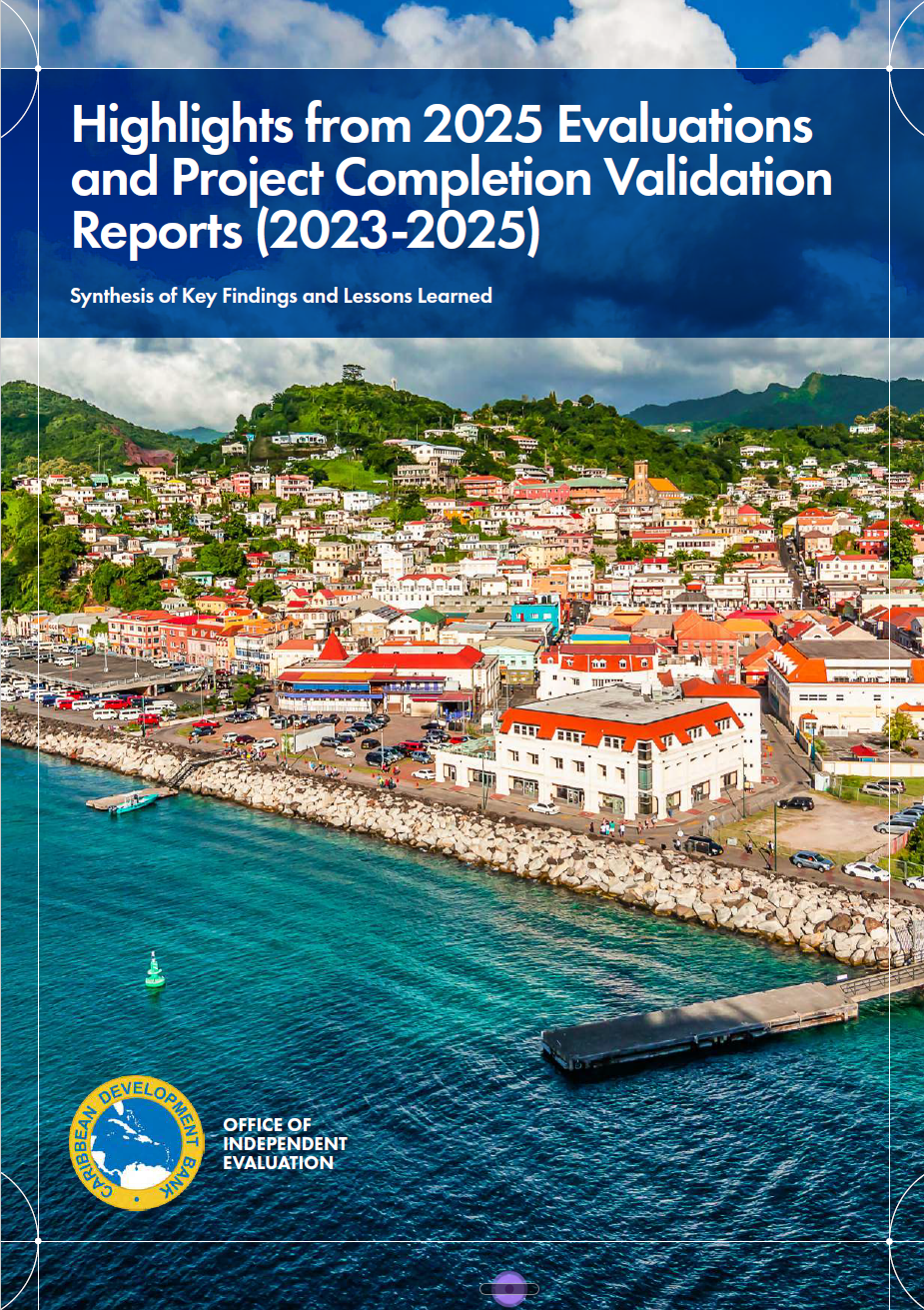
This document presents a synthesis of the main findings and lessons learned from evaluations completed in 2025 and published in early 2026, as well as from Project Completion Validation Reviews (PCVRs) conducted between 2023 and 2025. Together, these sources provide a consolidated view of the evidence emerging from the Caribbean Development Bank's recent evaluation portfolio.The evaluations and PCVRs offer important insights into what is working well, where challenges persist, and what lessons can be drawn to strengthen future programming. They provide evidence for the Bank, its Borrowing Member Countries (BMCs), and the Board of Directors to inform decision-making, enhance development effectiveness, and strengthen the design and implementation of future interventions.
Evaluation of the Caribbean Development Bank’s Environmental and Social Review Procedures 2014- 2022
Evaluation Report
Corporate
Complete
CDB
Summary
The current version of the Caribbean Development Bank’s (CDB) Environmental and Social Review Procedures (ESRP) document was approved in 2014 and built on earlier experience in the application of the Bank’s Environmental Review Guidelines (1994) and the Guidelines for the Social Analysis of Projects (2004). The ESRP outlines how CDB, within its mandate and operations, ensures that environmental and social risks are managed. The ESRP include eight environmental and social performance requirements (PRs) to:Optimise decision-making with respect to environmental and social impacts, and risks to anticipate, avoid, mitigate, and/or compensate for adverse project impacts on the environment and affected people and communities. Assist Borrowing Member Countries (BMCs) to build capacity and strengthen their institutions and governance systems to manage environmental and social risks effectively. Provide staff, BMCs, and other development partners with a clear understanding of CDB’s requirements, and procedures, accountabilities for managing environmental and social risks in its operations. The Environmental Sustainability Unit (ESU) is responsible for updating and revising the ESRP, developing other policies/procedures, familiarising and training staff, and providing general guidance. The ESU and the Social Sector Division (SSD) are also involved in project work, coordinating project appraisal and supervision, and providing technical inputs.