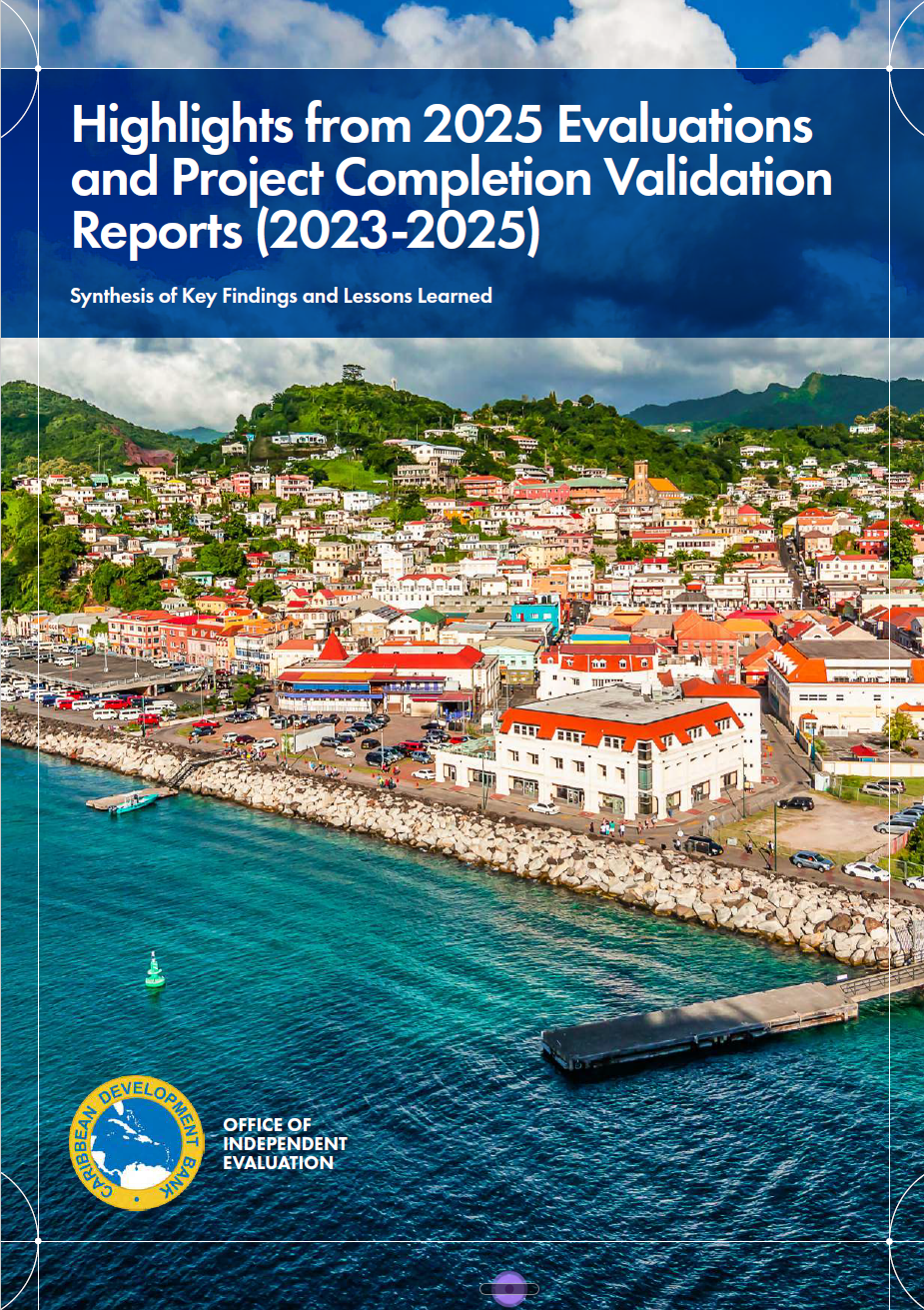
This document presents a synthesis of the main findings and lessons learned from evaluations completed in 2025 and published in early 2026, as well as from Project Completion Validation Reviews (PCVRs) conducted between 2023 and 2025. Together, these sources provide a consolidated view of the evidence emerging from the Caribbean Development Bank's recent evaluation portfolio.The evaluations and PCVRs offer important insights into what is working well, where challenges persist, and what lessons can be drawn to strengthen future programming. They provide evidence for the Bank, its Borrowing Member Countries (BMCs), and the Board of Directors to inform decision-making, enhance development effectiveness, and strengthen the design and implementation of future interventions.
Disaster Mitigation and Restoration: Rockfall and Landslip - Grenada (2014)
Climate
Project Completion Validation Report
Complete
Grenada
Summary
Since the early 1970s, landslides have presented a direct safety hazard to persons living in affected areas or using the major roads along Grenada’s coasts and have posed a threat to the coastal road infrastructure. Three of the major roads in Grenada that form the arteries of the Strategic Highway Network are the Western Main Road; the Eastern Main Road; and the Grand Etang Road. Damage on these roads resulting from hurricanes Ivan and Emily had increased the risk factor (to medium and high) for many of the vulnerable sites where road collapse from landslides and erosion was imminent and posed considerable risk to human life, private and public property, natural assets, economic production, and communication and transportation infrastructure. Given the vital role of the road network and the major impact and disruption caused to the economy and society, GOGR decided to assess and address the risks and vulnerability of 42 sites.