This document presents a synthesis of the main findings and lessons learned from evaluations completed in 2025 and published in early 2026, as well as from Project Completion Validation Reviews (PCVRs) conducted between 2023 and 2025. Together, these sources provide a consolidated view of the evidence emerging from the Caribbean Development Bank's recent evaluation portfolio.The evaluations and PCVRs offer important insights into what is working well, where challenges persist, and what lessons can be drawn to strengthen future programming. They provide evidence for the Bank, its Borrowing Member Countries (BMCs), and the Board of Directors to inform decision-making, enhance development effectiveness, and strengthen the design and implementation of future interventions.
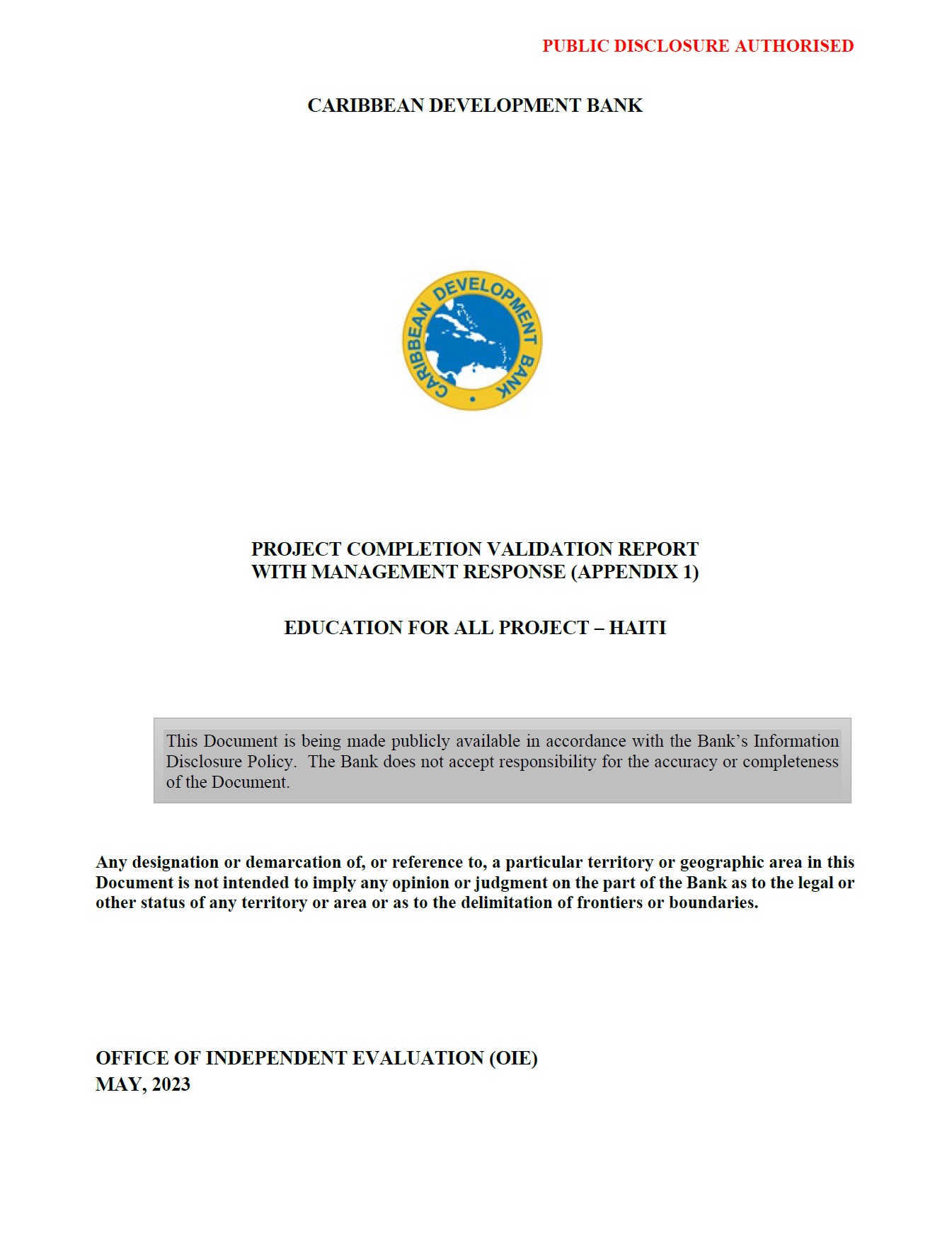
Education for All - Haiti (2023)
Education
Project Completion Validation Report
Complete
Haiti
Summary
In May 2007, the Caribbean Development Bank (CDB) approved a grant in the amount of ten million United States dollars (USD10 mn) to the Government of the Republic of Haiti (GOH) for the Education For All Project. In December 2013, CDB approved an Additional Grant in the amount of USD10 mn in response to the disruption of education services caused by an earthquake that devastated the country in January 2010. There was a counterpart contribution of USD2.50 mn. The project’s overall objective was to contribute to social and economic development through a better-educated population. The goal was to increase access to primary education for disadvantaged children by: (a) strengthening public and non-public sector partnerships, (b) enhancing school management capabilities to increase access, and (c) improving equity and monitoring learning outcomes at the primary level. The assessment focused on the project’s relevance, effectiveness, efficiency, sustainability, and CDB's and the Borrower’s performance.