This document presents a synthesis of the main findings and lessons learned from evaluations completed in 2025 and published in early 2026, as well as from Project Completion Validation Reviews (PCVRs) conducted between 2023 and 2025. Together, these sources provide a consolidated view of the evidence emerging from the Caribbean Development Bank's recent evaluation portfolio.The evaluations and PCVRs offer important insights into what is working well, where challenges persist, and what lessons can be drawn to strengthen future programming. They provide evidence for the Bank, its Borrowing Member Countries (BMCs), and the Board of Directors to inform decision-making, enhance development effectiveness, and strengthen the design and implementation of future interventions.
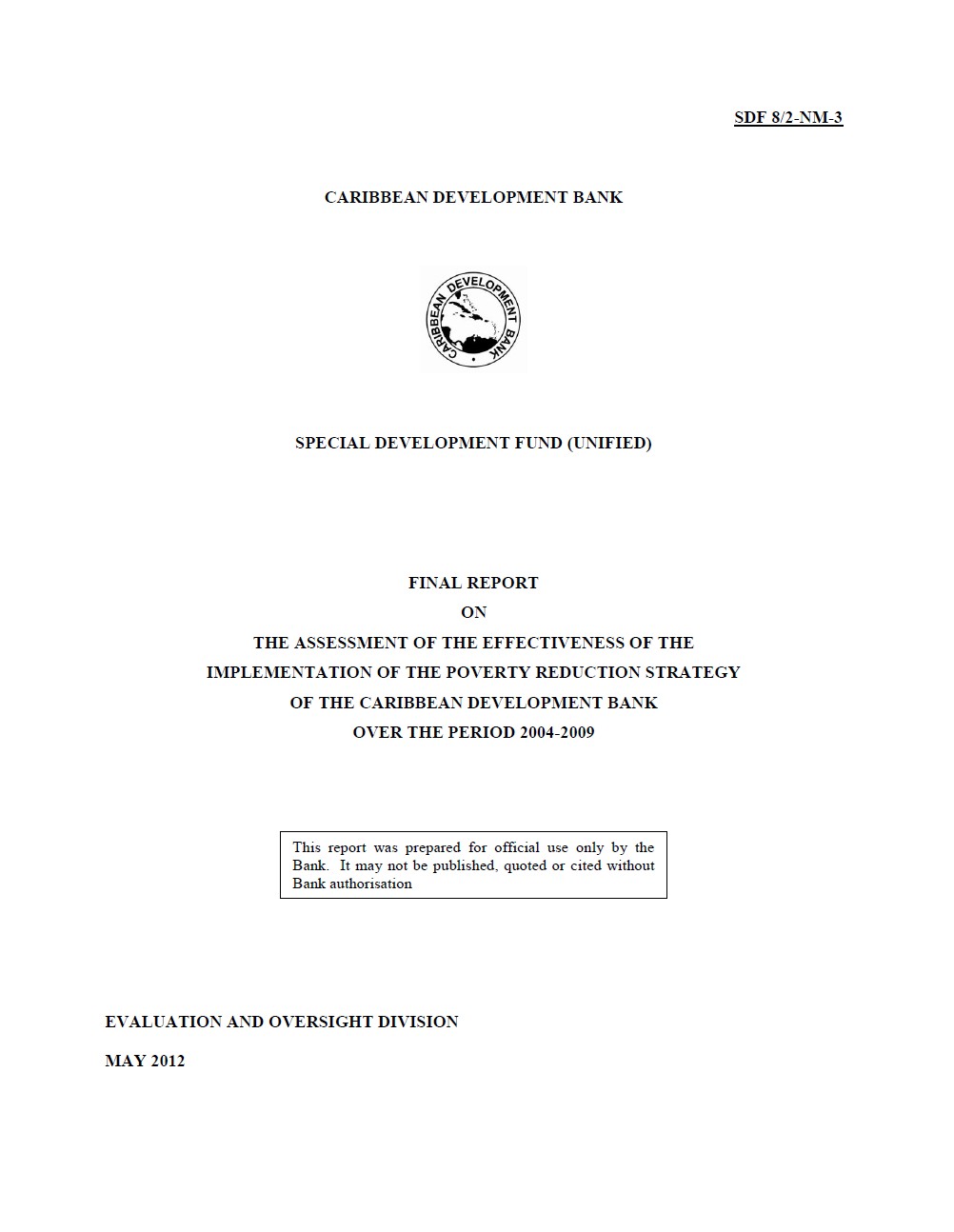
Final Report on the Assessment of the Effectiveness of the Implementation of the Poverty Reduction Strategy of the Caribbean Development Bank over the Period 2004-2009
Poverty Alleviation
Evaluation Report
Corporate
Complete
CDB
Management Response
Yes
Summary
Poverty reduction has featured as a development priority of the Caribbean Development Bank (CDB) for several cycles, in particular in the context of the Special Development Fund (SDF). Successive reviews of SDF focused on what has been done in terms of poverty reduction in the context of the SDF facility, but not on how CDB as an organisation has operationalised its poverty reduction efforts beyond the SDF framework. This report assesses the effectiveness of the implementation of Poverty Reduction Strategy (PRS) over the period 2004-2009, within the context of the standard evaluation criteria - Relevance, Efficiency and Efficacy.