This document presents a synthesis of the main findings and lessons learned from evaluations completed in 2025 and published in early 2026, as well as from Project Completion Validation Reviews (PCVRs) conducted between 2023 and 2025. Together, these sources provide a consolidated view of the evidence emerging from the Caribbean Development Bank's recent evaluation portfolio.The evaluations and PCVRs offer important insights into what is working well, where challenges persist, and what lessons can be drawn to strengthen future programming. They provide evidence for the Bank, its Borrowing Member Countries (BMCs), and the Board of Directors to inform decision-making, enhance development effectiveness, and strengthen the design and implementation of future interventions.
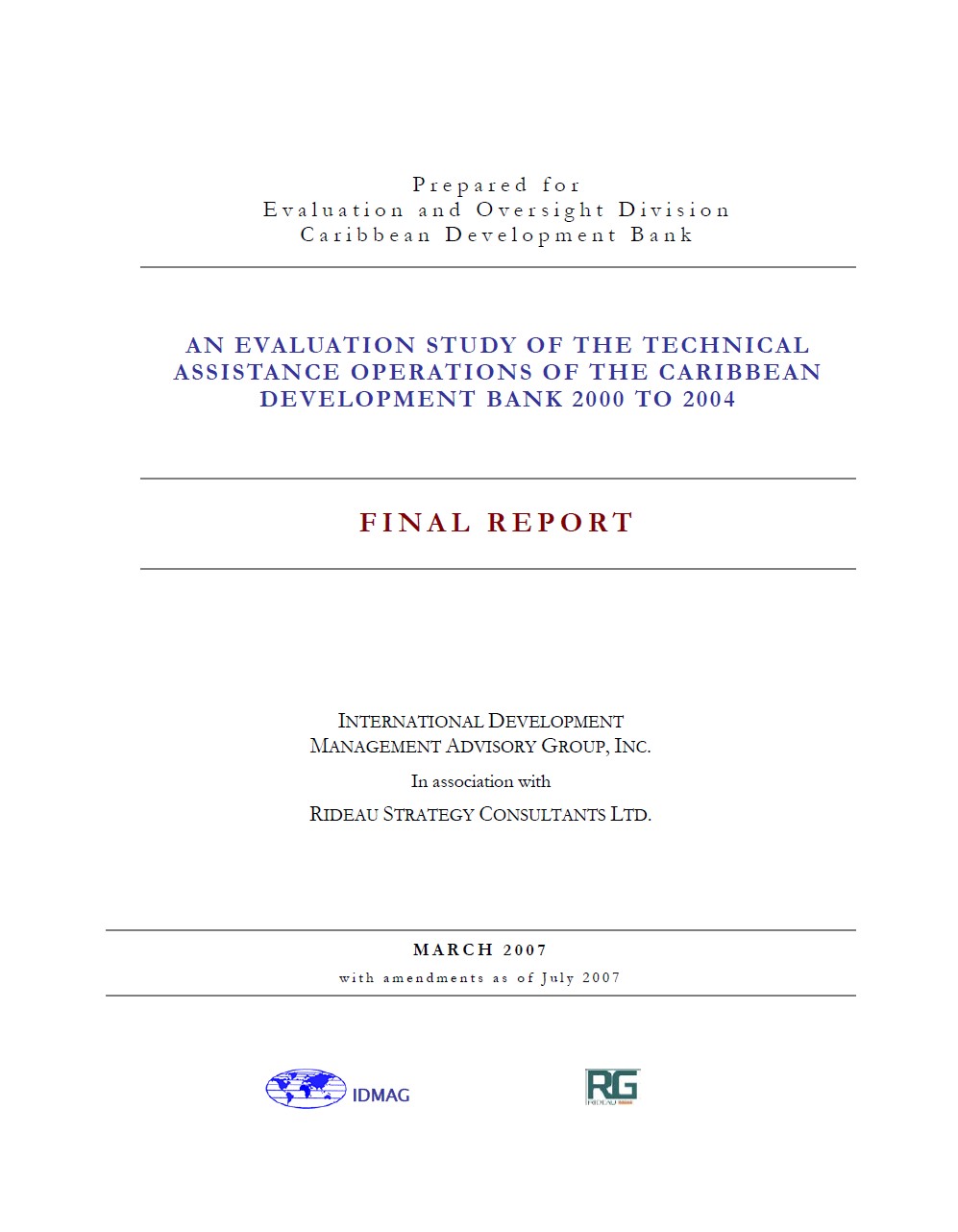
Evaluation of Technical Assistance Operations 2000-2004
Poverty Alleviation
Evaluation Report
Corporate
CDB
Management Response
Yes
Summary
This is the latest in a series of periodic programme evaluation studies on the technical assistance (TA) operations of the Caribbean Development Bank. It covers the period 2000-2004, with some retrospective analysis to provide a clearer understanding of trends and changes in TA operations.The report consists of 10 chapters, beginning with an Introduction, covering the study’s objectives, scope and context, and a chapter on Methodology. The third chapter provides a review of other TA evaluation studies and changing perspectives on technical assistance, followed by four chapters that summarize the analysis undertaken and the findings from that analysis. Chapters 4 and 5 provide an overview and analysis of TA operations generally, with a profile of CDB’s TA policy framework and TA operations over time, followed by a more detailed analysis of TA operations during 2000-2004. Each of these chapters looks at both overall TA operations, including a number of specialized programmes, in order to analyze changes over different time periods, and what is referred to as the general or core TA programme, which excludes the specialized programmes, and which is the particular focus of the study.Chapters 6 and 7 present the study’s analysis of a sample of TA projects using the Bank’s standard evaluation criteria with minor adaptations. The results of the analysis are presented first in terms of overall performance, and then for each individual performance criterion, with examples to illustrate the factors that influenced the performance rating and some of the key findings from the project sample.The final three chapters provide a summary of key findings and conclusions, options and recommendations, and lessons learned. Findings and conclusions of the Report reflect the information collected and analysis undertaken as of late 2006 when the Report was initially prepared. There has been some subsequent refinement of data in Chapters 4 and 5, and some further clarification of procedures for identifying the relevance of individual TAs to CDB’s strategic objectives and corporate priorities since 2004, as well as clarification of some of the recommendations in the light of discussion since the Report was first prepared.